
Specifications and technologies / Wi-Fi
MU-MIMO and OFDMA both help a Wi-Fi network serve multiple clients, but they work in different ways. OFDMA divides the frequency resources within a channel. MU-MIMO uses spatial streams. Neither is a separate service plan or a guarantee that a single phone will run faster.
The benefit depends on the access point, the clients, radio conditions and the type of traffic. To assess it, test with several devices active at the same time.
Why devices have to wait for airtime
Wi-Fi uses a shared medium. Devices coordinate access to the channel, and each transmission carries overhead. When many clients frequently send short packets, using airtime efficiently matters just as much as the peak physical data rate.
These mechanisms help devices share the available radio resources more efficiently. The total resources are still limited. For an introduction to OFDMA, see Cisco. Its explanation illustrates the difference between one large transmission and several small requests served at the same time.
How OFDMA divides a channel among clients
In Wi-Fi 6, the access point can assign groups of subcarriers called resource units (RUs) to individual clients within a coordinated transmission. Several compatible clients can each use part of the channel at once, freeing them from taking turns for every short exchange.
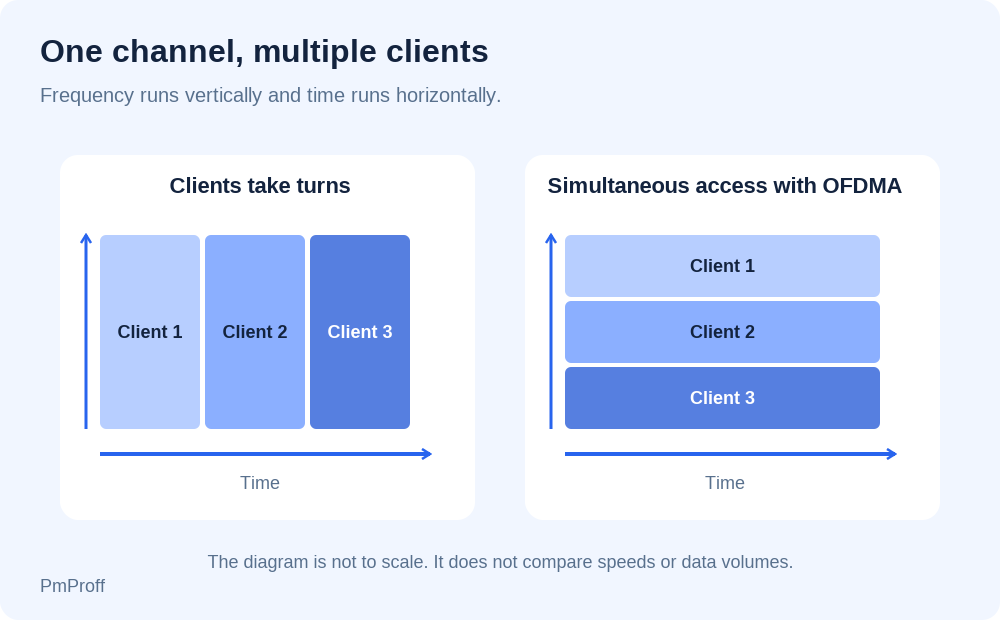
The scheduler determines the size of each allocation and the order in which clients are served. The diagram does not imply that every client always gets an equal share or that OFDMA is used for every packet.
How MU-MIMO separates spatial streams
MU-MIMO uses the spatial characteristics of the radio channel to carry independent streams to multiple clients. It requires suitable radios, antennas and client support. The access point must assess the channel and select a compatible group of clients that can operate simultaneously.
Counting external antennas cannot tell you how many users will see a speed increase at the same time. The supported spatial streams, direction of transmission and capabilities of the devices all matter. For differences between generations and the role of compatibility, see TP-Link’s explanation of MU-MIMO.
How these features relate
| Mechanism | What it allocates | What to check |
|---|---|---|
| OFDMA | Frequency resources within a coordinated transmission | Client support, uplink/downlink support and configuration |
| MU-MIMO | Spatial streams among clients | Radio configuration and client capabilities |
| Single-user (SU) transmission | Serves one client in a given transmission | Can be an appropriate mode for the traffic |
The mechanisms can coexist. Which one is used depends on traffic and implementation. The Cisco documentation for 802.11ax describes multi-user operation in both directions. Check the manual for your home access point to see which features of the standard that model supports.
When you may notice a difference
Test while several people are working, making calls and transferring data at the same time. Alongside peak download speed, measure latency under load, call stability and response times. A single speed test next to the router may miss the benefit of multi-user operation.
Weak coverage, a channel congested by neighbouring networks and a slow WAN connection still limit performance. Start by checking access point placement and the links between access points. MU-MIMO cannot compensate for poor coverage planning.
Enabling the feature will not turn an older client into a Wi-Fi 6 device. Older devices can stay on the network, but they do not automatically gain all the capabilities of the new standard.
Practical checks
- Identify the Wi-Fi standard and radio configuration of the access point and clients.
- Check the current supported firmware and the OFDMA/MU-MIMO settings.
- Rule out bottlenecks on the WAN and wired connections.
- Repeat the same test with several clients active.
- Compare latency and stability as well as peak speed.
Frequently asked questions
Are OFDMA and a 160 MHz channel width the same thing?
No. Channel width determines the total frequency resources available. OFDMA determines how those resources are divided among clients.
Should I disconnect older devices?
You may not need to. Check compatibility and measure their actual impact before deciding on the basis of age alone.
Does MU-MIMO extend range?
Extending coverage is not its primary purpose. Placement, antennas and radio conditions matter for range and connection stability.
In brief
OFDMA divides frequency resources. MU-MIMO uses spatial streams. Evaluate them with multiple compatible clients active at the same time.