
Specifications and technology / Power
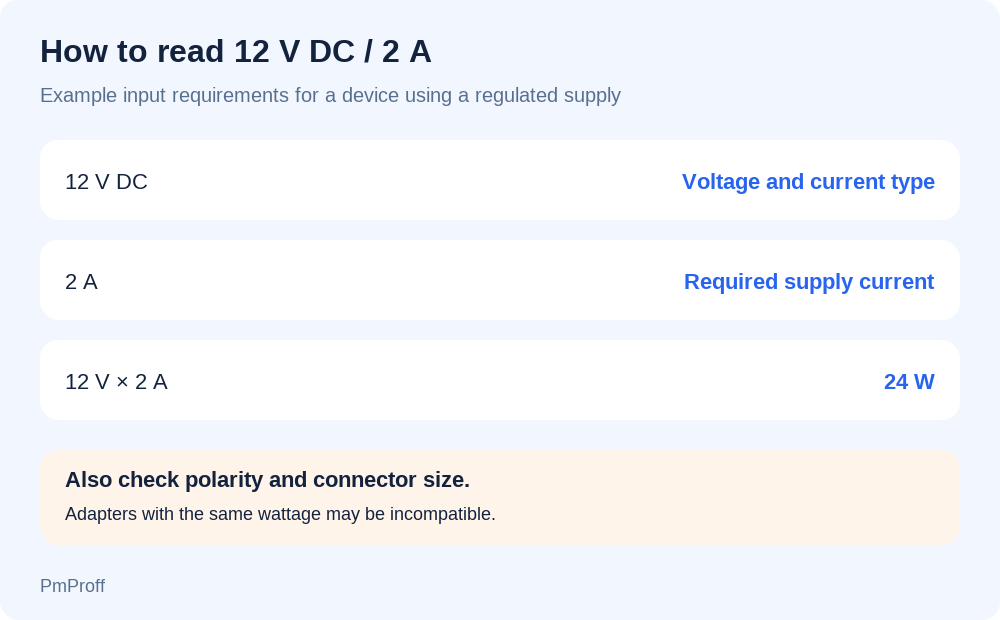
The label 12 V DC / 2 A specifies two requirements: supply voltage and the current the source must provide. Their product is 24 W. Adapters with the same wattage can still be incompatible.
For a camera, router or controller, check voltage, current type, polarity, connector and available power. A plug that fits is only one of these checks.
Volts, amperes and watts
| Symbol | Meaning | Example |
|---|---|---|
| V | Voltage | 12 V at the device input |
| A | Current | Supply rated for 2 A |
| W | Power | 12 V × 2 A = 24 W |
| Wh | Energy | Used to estimate the energy stored in a battery |
For steady DC operation, use P = U × I. This is an arithmetic check. Use the data sheet for startup loads, losses and special operating modes. Estimating AC mains consumption requires additional parameters.
Input and output ratings
On a power supply, Input describes the incoming supply, such as AC mains. Output describes what the supply delivers to the equipment. Input on the device itself specifies what it must receive. Compare the adapter output with the device input.
AC means alternating current and DC means direct current. A 12 V AC adapter is unsuitable as a direct replacement for a 12 V DC one. Check the polarity symbol: on a barrel connector, the centre contact and outer sleeve can have different assignments. Similar-looking plugs can also have different inner diameters.
MEAN WELL instructs users to check voltage and current against the equipment requirements before connection. Use the intended connection for enclosed mains adapters. Work on exposed mains terminals requires a qualified specialist. MEAN WELL instructions.
Can I use a supply with a higher current rating?
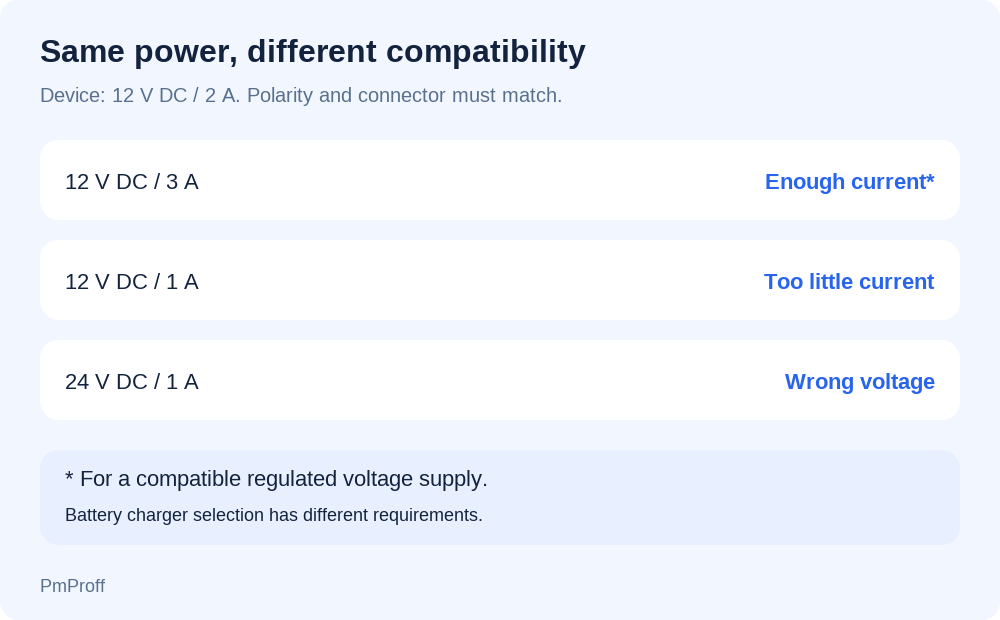
If a compatible regulated constant-voltage supply has a higher current rating, it can support a larger load. The device draws the current it needs. Voltage must still match, and current headroom does not remove the need to check polarity, connector and operating conditions.
An undersized supply may shut down or fail to maintain voltage during load peaks. A lit indicator alone does not confirm compatibility. Check the most demanding operating mode, such as a camera switching on its illuminator. CUI on selecting an AC/DC supply.
A battery requires a suitable charging algorithm, voltage and current limit. Never connect it directly to an arbitrary adapter just because both labels say “12 V”. Constant-current LED drivers also require different selection criteria from ordinary DC adapters.
Why cable and temperature matter
Voltage drops along a cable. A long cable or conductors with insufficient cross-section can leave less voltage at the load than at the supply output. Check the device’s permitted input range and the cable run before considering any change. Do not simply raise the adapter voltage.
The permitted load can also depend on temperature, ventilation and enclosure orientation. Manufacturers publish derating curves for this purpose. Both topics are covered in the MEAN WELL technical FAQ.
Five checks before connecting
- Find the input specifications for your exact model.
- Match AC or DC, nominal voltage and permitted voltage range.
- Check the available current and power at peak load.
- Verify polarity, connector dimensions and cable condition.
- Check temperature limits and mounting requirements.
If the description lists DC and PoE, check the instructions before connecting both. They may be alternatives. Likewise, a USB-C connector alone does not guarantee the required mode. Verify the power profiles supported by the device, adapter and cable.
Input, output and multiple load channels
Input voltage and current describe the source that powers the supply. Output voltage and current describe what it delivers to the load. Conversion losses prevent a direct equivalence, and AC input also involves power factor. Device power consumption describes a rate, distinct from an energy reserve.
The number of load channels tells you how many output lines there are. Total power is still shared within the supply rating. Check the limit for each channel and the sum of simultaneous loads. Multiple terminals for a single output may be electrically common. Multi-output supplies can also have minimum load and cross-regulation requirements. MEAN WELL discusses these limits in its FAQ.
Power supply type matters. A switched-mode supply converts voltage, but continued operation during a mains outage requires backup capability and a battery. Read “nominal voltage” against the specific input, output or battery to which it refers.
How to read power specifications for different devices
“Power supply” may specify a voltage or battery type, while “Device power” may list the available supply methods. If both DC and PoE appear, check whether they are alternatives and which PoE standard is supported. An RJ45 connector alone does not establish power delivery. Where several DC or USB outputs are listed, check each port’s voltage and polarity, and the combined load limit.
Short-circuit, overload, overtemperature, reverse-polarity and deep-discharge protection address different faults. One feature does not imply the others. Correct connections remain essential even with automatic shutdown. Check thresholds, recovery behaviour and thermal derating in the data sheet. A 70/100 V audio line serves a different purpose from a power supply’s mains input. See the guide to distributed audio.
Frequently asked questions
Can a 24 V, 1 A supply replace a 12 V, 2 A supply if both are rated at 24 W?
No, unless the device accepts 24 V. Matching wattage cannot compensate for the wrong voltage.
Why does the device restart under load?
Possible causes include an undersized supply, cable voltage drop or another fault. Diagnose the cause before replacing anything. An arbitrary higher-voltage adapter can damage the device.
Does a 36 W supply always consume 36 W?
No. That figure is its rated output under specified conditions. Actual consumption depends on the load and conversion losses.
Match voltage and supply type first, then check available current, polarity and connector. A higher wattage alone does not establish compatibility.