
Specifications and technology / Automation
Rocker count, number of control locations and frame format describe different properties. Two rockers do not automatically provide control from two locations. A panel that looks right may still be incompatible with the relay.
Rockers and control locations
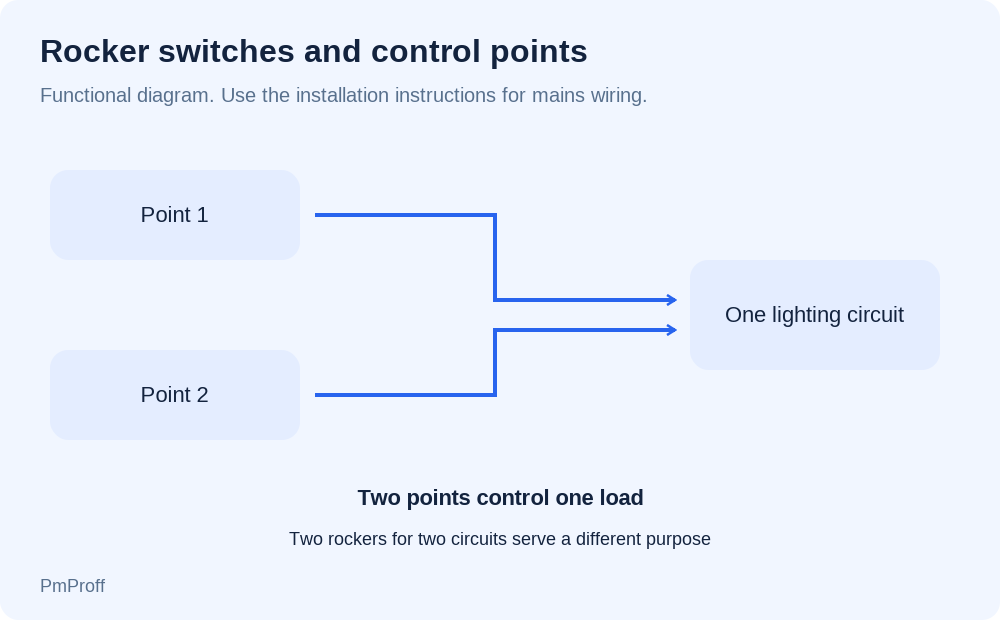
A single or double rocker describes how loads are controlled. Two-way switching allows one lighting circuit to be controlled from different locations. Intermediate switches are used in appropriate multiway arrangements. For electronic systems, the manufacturer defines the control logic and permitted combinations. A smart relay with a similar name need not follow a mechanical switch’s wiring diagram. This guide covers component selection. Use the specified installation instructions for mains wiring.
Choosing a compatible relay, panel and frame
In a modular system, the switching unit, touch panel and frame may be sold separately. The LightSwitch 2-gang/2-way manual distinguishes standalone and combined installations and their components. List the exact part numbers before ordering. Check orientation, frame positions, side or centre panel placement and compatibility across generations.
| Feature | What it describes |
|---|---|
| Number of rockers | Arrangement of controls |
| Two-way / intermediate | Function within the configuration |
| Standalone / combined | Mechanical component set |
| Frame positions | Number of installed modules |
A shared frame can contain separate circuits
Two devices in the same frame can control different circuits. Frame position count is separate from the rocker or channel count of a single relay. The Ajax LightSwitch guide explains how to choose side and centre panels. Check availability of the intended horizontal or vertical combination, especially if it includes a socket. Never trim an incompatible panel to make it fit.
Electrical load and mounting requirements
Check the lamp type, minimum and maximum relay load, neutral requirement and mounting box. These vary by model. For flickering or unstable operation, use only a remedy specified by the manufacturer. Never add arbitrary components. Have a qualified electrician connect and test the mains side. After installation, check every control location, power restoration and local operation without the app.
Checks before choosing
- Identify the load and control locations.
- List compatible part numbers.
- Verify the frame and orientation.
- Arrange installation and test all operating modes.
Frequently asked questions
Does a double rocker provide two-way switching?
Not necessarily. These describe different features.
Will any frame of the same size fit?
No. Check the series, panel position and mechanical compatibility.
Will a no-neutral relay work with any lamp?
Not necessarily. The model’s load requirements still apply.
In brief
Define the required function first, then select compatible relays, panels and frames. Check the complete set even when parts look alike.