
Specifications and technology / Electrical installation
An E90 marking on a box does not guarantee that any circuit assembled with it will continue to operate during a fire. The tested configuration, compatible components and installation conditions all matter.
The classification applies under specified conditions
The OBO catalogue of tested systems describes FireBox boxes as components of systems tested for electrical circuit integrity under a defined method. E30/E60/E90 classifications differ from IP dust and water ratings and from enclosure flammability classes. Obtain the documentation for the actual manufacturer and product. OBO’s example cannot establish the classification of a different box with a similar label.
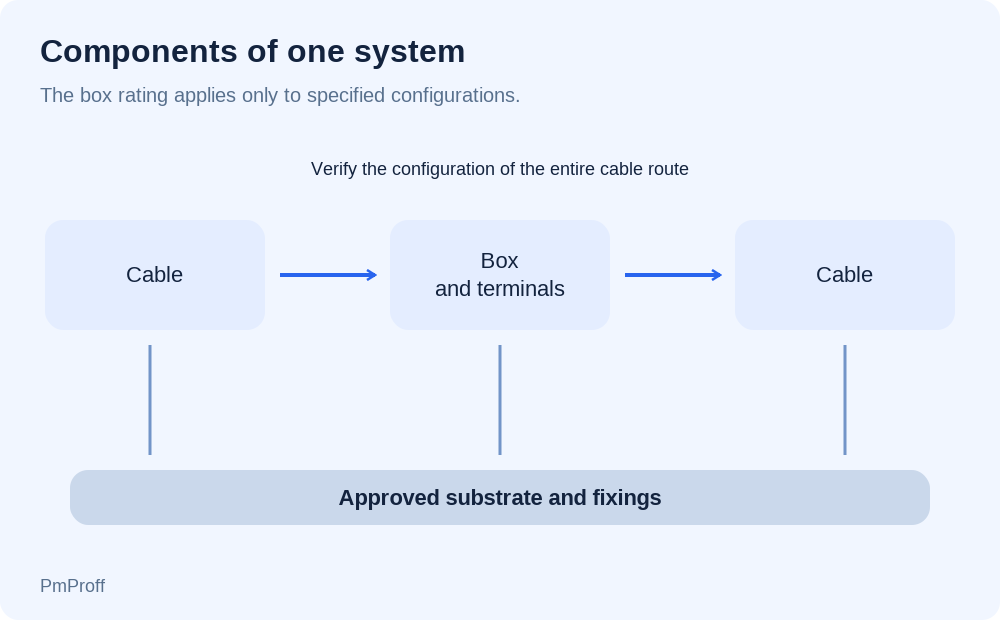
Box, cable and fixings work together
Ask for the approved cable types, fixing methods, substrates and mounting positions. Substituting one component can put the installation outside the verified configuration. The designer must assess the whole route, including joints and penetrations. A single catalogue entry cannot establish site compliance. If product documentation is unavailable, a general article cannot take its place.
| Catalogue entry | Check |
|---|---|
| E90 | System documentation and configuration |
| Voltage / current | Limits of the terminal assembly |
| Terminals | Poles and permitted conductors |
| Cable entries | Number, dimensions and seals |
Current and voltage are separate limits
“Switching voltage” in a box listing may refer to the rated voltage of the terminal assembly. It does not necessarily indicate a switch. Maximum circuit current depends on the specified conditions and compatible conductors. Check the exact data sheet wording. Ratings of 250 or 500 V and 10 or 30 A do not permit arbitrary combinations of conductor cross-section, temperature and connection method. Have a qualified specialist select and install the equipment.
Cable entries and terminal poles
Cable entry count describes the positions through which cables enter the box. Terminal poles describe the arrangement of electrical connections. Six entries do not imply six independent circuits. The entry hole diameter is separate from conductor cross-sectional area. Check terminal material, permissible conductors and clamping method. Keep the data sheet and a record of the installed configuration for maintenance.
Information for the designer
Provide the box part number, cable types, substrate, expected loads and required circuit function. Ask the designer to confirm that the documentation applies and to specify acceptance checks. The appearance of ceramic terminals or metal fixings cannot establish fire test performance. Never carry out your own fire test. Even an ordinary connection without a fire-resistance requirement must meet its electrical ratings.
Checks before choosing
- Obtain the documentation for the exact product.
- Match the cables, fixings and substrate.
- Check electrical limits and cable entries.
- Agree on the design with the system designer.
Frequently asked questions
Does E90 mean IP90?
No. The ratings describe different properties and use different test methods.
Is replacing an ordinary box with an E90 box enough?
The full configuration must be assessed before that can be established.
Does the number of cable entries equal the number of circuits?
No. Entries and electrical connections describe different parts of the product.
In brief
A fire-resistant circuit requires a documented system and correct installation. One component marking cannot certify the entire cable route.