
Specifications and technology / Sensors
An indoor climate monitor can combine several independent measurements. Temperature, relative humidity and CO₂ concentration each tell you something different. Never use a CO₂ sensor in place of a carbon monoxide (CO) alarm.
Three measurements with different meanings
Temperature is measured in degrees, relative humidity as a percentage and CO₂ concentration often in ppm. These values cannot be compared directly. Relative humidity depends on temperature, so a percentage change need not correspond to the same change in the amount of water vapour. Consider trends, sensor location and room conditions alongside any individual reading.
What does NDIR mean?
Nondispersive infrared (NDIR) sensing measures a gas by its absorption of infrared radiation. The LifeQuality manual describes a dedicated NDIR CO₂ channel and a temperature/humidity sensor. A temperature sensor built into a security device does not automatically make it a dedicated indoor climate monitor. Check the accuracy, range, update interval and calibration conditions for your model.
| Metric | What to check |
|---|---|
| Temperature | Accuracy and measurement location |
| Humidity | Relative value and temperature |
| CO₂ | Sensing principle, range and calibration |
| History | Data retention when the connection is lost |
CO₂ and CO are different gases
Carbon dioxide (CO₂) and carbon monoxide (CO) require different detection methods. A CO₂ monitor cannot serve as a fire or CO alarm. Indoor climate readings cannot confirm the absence of hazardous gases. Use equipment designed for fire protection and follow its instructions. This guide explains equipment specifications and does not establish medical or emergency thresholds.
Placement and calibration
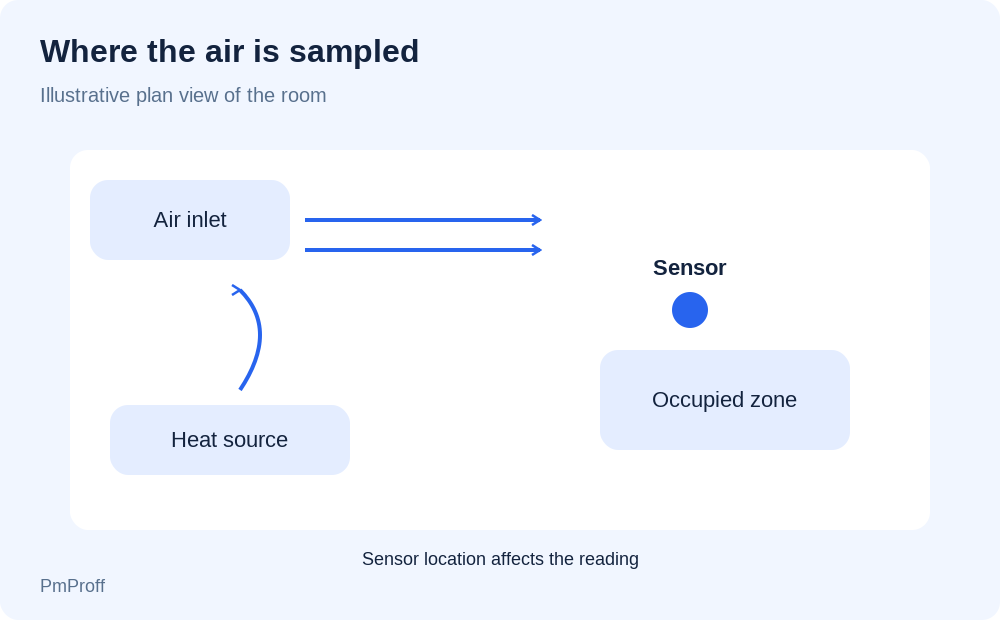
Choose a representative location as well as a convenient power outlet. Direct airflow from ventilation, sunlight or a nearby heat source can distort the reading for the room. Follow the recommended clearances and calibration procedure. Automatic calibration relies on different assumptions across models. Never run manual calibration simply to obtain an expected number. After moving the sensor, allow conditions to stabilise before comparing readings.
From trend graphs to automation
Check which readings and history the app displays. Ajax describes the available measurements separately from control scenarios. Automation requires a compatible actuator and a suitable return-to-normal rule. Using one threshold for both starting and stopping can cause frequent switching unless the control logic prevents it. Check the event log, delays, communications and behaviour when the sensor is unavailable.
Checks before choosing
- Distinguish CO from CO₂.
- Check the sensing method and accuracy.
- Choose a representative measurement point.
- Check data history and safe automation behaviour.
Frequently asked questions
Can a CO₂ sensor replace a CO alarm?
No. They detect different gases and serve different purposes.
Are all temperature sensors equally accurate?
No. Compare specified accuracy and measurement conditions.
Must calibration always be started manually?
No. Follow the procedure for the specific model.
In brief
Compare each measurement channel, its accuracy and its location. Indoor climate monitoring cannot replace an emergency protection system.