
Specifications and technology / Equipment protection
IP65, IP66 and IP67 specify how an enclosure resists the entry of solids and water. General reliability and all-weather operation require other checks.
When choosing a camera, sensor or junction box, read both digits and check the installation requirements. Consider temperature, sunlight and mechanical impacts separately.
What the two digits mean
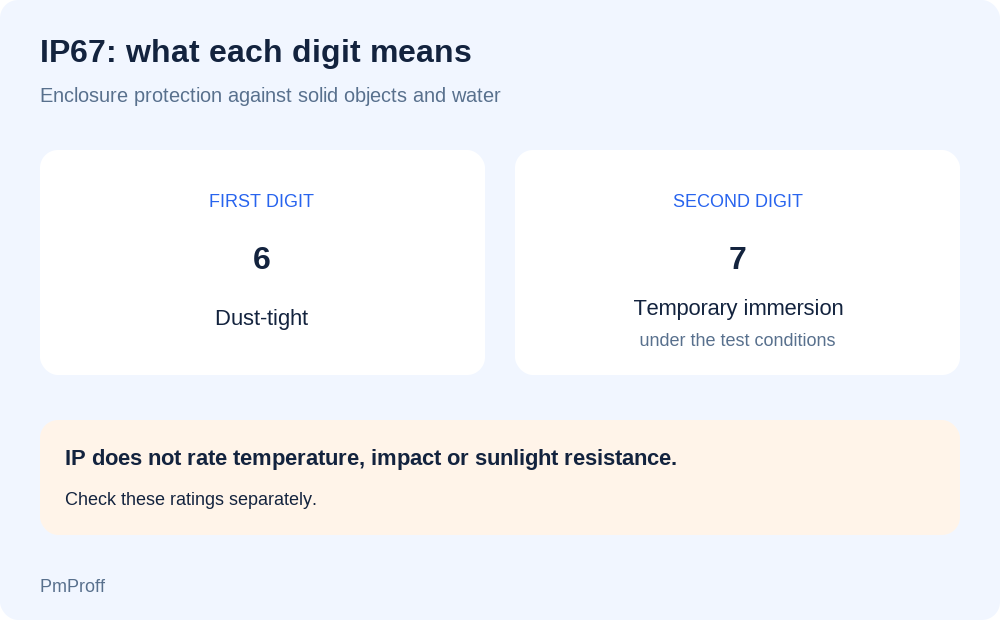
The IP code under IEC 60529 has two principal digits. The first covers solid foreign objects and dust, and the second covers water. For example, the 6 in IP67 means dust-tight, while the 7 indicates temporary immersion under specified test conditions. The two digits are separate ratings, never a percentage. Axis guide to IP ratings.
Common ratings compared
| Rating | Solid objects | Water |
|---|---|---|
| IP20 | Objects 12.5 mm and larger | No protection claimed |
| IP54 | Dust-protected enclosure | Splashing |
| IP65 | Dust-tight | Water jets |
| IP66 | Dust-tight | Powerful water jets |
| IP67 | Dust-tight | Temporary immersion |
| IP68 | Dust-tight | Immersion under manufacturer-specified conditions |
The table summarises test exposures. Do not use it to test equipment with water yourself. Suitability in use depends on the stated conditions, enclosure condition and installation. See the full description in the Axis guide.
Why IP67 does not always cover IP66
Water jets and immersion stress seals differently. An IP67 marking alone does not authorise cleaning with a powerful jet. Axis explicitly distinguishes these tests. If a location requires both protections, look for both ratings and supporting documentation. Axis on IP66 and IP67.
The marking refers to specified tests. A damaged gasket, open port or incorrect installation can compromise protection.
Does IP67 mean a device is suitable for outdoor use?
No. Outdoor equipment must withstand more than dust and water. Check operating temperature, condensation, resistance to sunlight and permitted mounting methods. Axis documentation for onboard cameras specifically notes that IP66/67 alone does not establish suitability for external installation. Axis on outdoor camera use.
A sheltered camera and one beside a wash bay face different exposures even though both are outdoors. Before choosing a model, consider directed water jets, direct sun, dust and the need for impact resistance. Match the rating to the actual location.
Enclosure, cable gland and connector
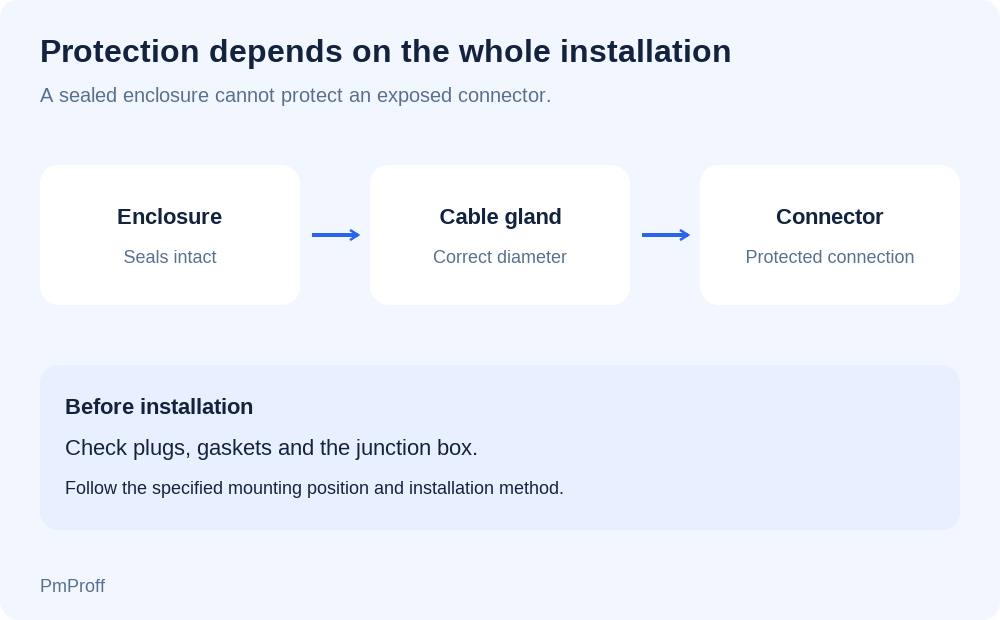
Plan the location of the cable connection. A sealed camera housing cannot protect an exposed connector beside it. Fit the junction box, plugs and supplied seal as instructed. Check that any third-party coupler preserves the claimed rating.
After maintenance, refit all gaskets and covers. If the manufacturer specifies a tightening torque, follow it. Overtightening does not necessarily improve the seal.
IP and IK measure different properties
For equipment within people’s reach, check resistance to mechanical impact separately. The IK code may describe this, while IP addresses ingress. A high IP rating does not establish impact resistance. Use manufacturer data for the particular risk, even if the housing looks sturdy.
What to check in a product listing
- The exact IP rating behind a description such as “water-resistant”.
- Approval for outdoor installation and the operating temperature range.
- The kind of water exposure at your site.
- Supplied seals and cable requirements.
- Whether separate mechanical protection is needed.
Frequently asked questions
Can an IP67 camera stay permanently underwater?
No. This marking covers temporary immersion under the test conditions. Underwater operation requires explicit manufacturer approval.
Is IP65 sufficient for any rainfall?
Check approval for outdoor use, installation requirements and the other conditions at the site alongside the rating.
Will a separate protective box help?
It can form part of the solution. Check the entry seals, heat buildup and mounting compatibility. A box on its own establishes none of these.
Choose protection for the specific exposure. The enclosure, accessories, temperature range and mounting method must suit the installation site.