
Specifications and technology / Backup power
A 100 Ah rating does not mean 100 hours of runtime. Runtime depends on battery voltage, usable energy and the combined consumption of all connected devices.
For a first estimate, convert capacity to watt-hours, allow for permitted discharge and losses, then divide by the load in watts. The result is an estimate.
Amp-hours, watt-hours and watts
| Symbol | Quantity | Use |
|---|---|---|
| Ah | Electric charge | Comparing capacity at a specified voltage and under stated test conditions |
| Wh | Energy | Estimating the energy available to the load |
| W | Power | How much energy a device consumes per unit of time |
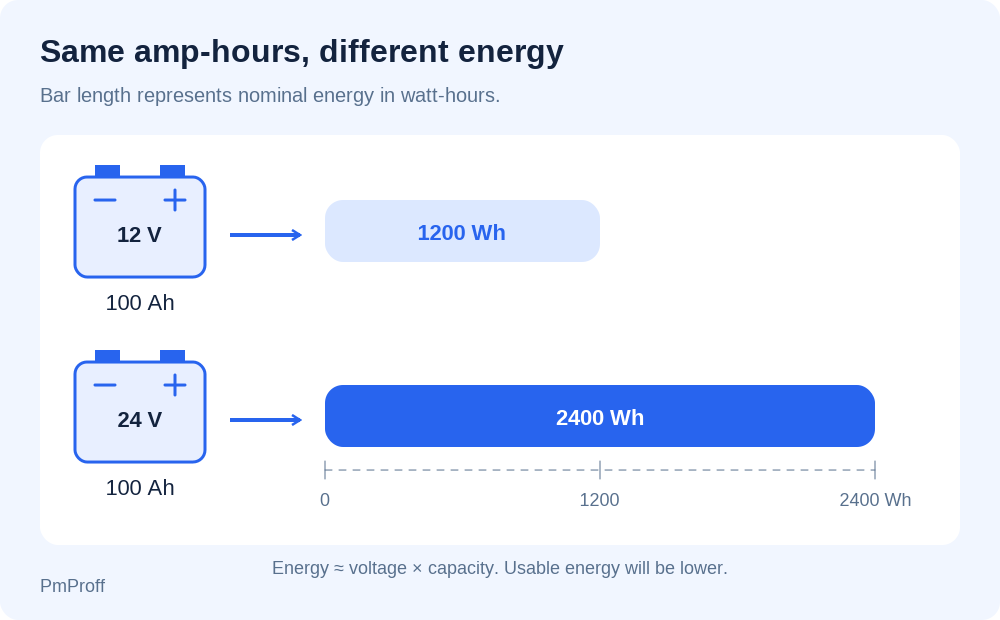
Approximate conversion: E = U × C. A 12 V, 100 Ah battery holds about 1200 Wh nominally, while a 24 V, 100 Ah battery holds about 2400 Wh. Identical amp-hour ratings can represent different amounts of energy.
Use the manufacturer’s watt-hour figure if available. Voltage changes during discharge, so multiplying nominal values is an approximation.
Approximate runtime formula
t ≈ E × d × η ÷ P, where E is nominal energy in Wh, d is the usable discharge fraction, η is overall conversion efficiency and P is average load in watts. Enter 80% as 0.8, for example.
Use the documented depth of discharge, BMS or UPS cutoff and converter efficiency for your equipment. If the data sheet already gives usable output energy, applying the same factors again will underestimate runtime.
Example for a router and optical network terminal
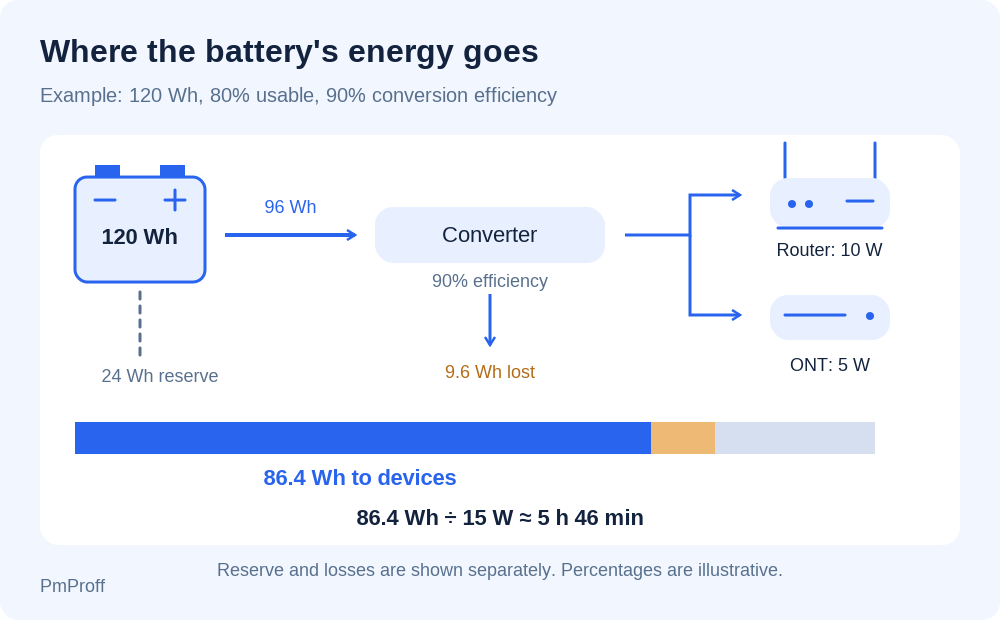
Suppose the router draws 10 W and the ONT draws 5 W, for a total of 15 W. With 120 Wh nominal energy, a usable fraction of 0.8 and efficiency of 0.9, the estimate is 120 × 0.8 × 0.9 ÷ 15 = 5.76 hours, or approximately 5 hours 46 minutes.
These factors are illustrative. Verify runtime with a controlled test: loads vary, batteries age and the converter draws some power itself. This overhead matters particularly with a low-power router.
Finding actual consumption
An adapter marked 12 V, 2 A often gives its maximum output capacity. The router may draw much less. Measure typical and peak consumption where possible. A camera, for example, may draw more at night when its illuminator switches on.
List every load: router, ONT, switch, cameras and recorder. If you measure consumption at the system input, its power supply losses are already included.
Why actual runtime may be shorter
Usable lead-acid capacity depends on discharge rate. A 100 Ah rating measured over 20 hours does not guarantee 100 A for one hour. This is described by Peukert’s law. Temperature, battery condition and the equipment’s cutoff threshold also matter. Victron’s explanation.
A large watt-hour rating does not guarantee that a battery or inverter can support any load. Check continuous current, startup peaks, BMS limits and system output power.
What to check before purchase
- Required runtime and maximum consumption.
- Nominal battery voltage and energy.
- Permitted discharge and current in the data sheet.
- Converter losses and self-consumption.
- Charging time between outages.
- Allowance for ageing and cold conditions.
Frequently asked questions
How long will a 100 Ah battery last?
You need the voltage, load and battery type to estimate this. Convert capacity to watt-hours and check the permitted discharge.
Why do power banks with the same mAh rating last different lengths of time?
Capacity may refer to the internal cells. The output operates at a different voltage and conversion incurs losses. Compare watt-hours and usable energy at the output you need.
Will a battery keep my internet connection working during an outage?
It can power your equipment, but connectivity also depends on backup power on the ISP’s network. Ask your provider about this separately.
Runtime depends on watt-hours and actual load as well as amp-hours. Calculate an estimate to choose a system, then measure actual performance with a controlled test.