
Specifications and technology / Batteries
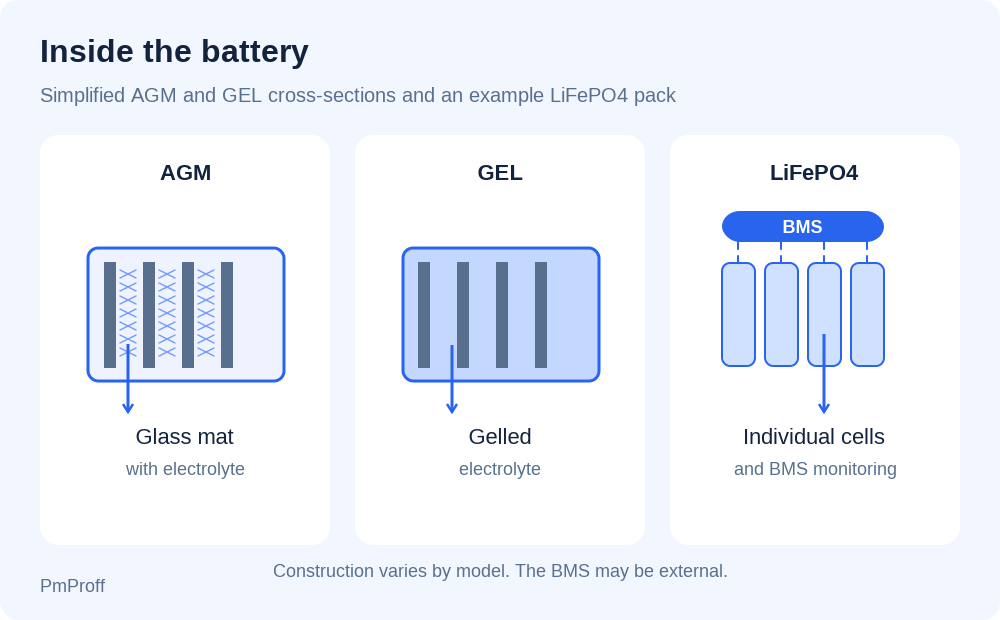
AGM and GEL are lead-acid battery types. LiFePO4 is a lithium chemistry. Similar voltage markings alone do not make them interchangeable.
Backup power requires a compatible charger, suitable duty cycle and enough usable energy. A battery that suits occasional short outages may be a poor choice for daily deep cycling.
What AGM, GEL and LiFePO4 mean
| Type | Characteristic | Main check |
|---|---|---|
| AGM | Electrolyte held in a glass fibre mat | The model’s float or cyclic service rating |
| GEL | Gelled electrolyte | Charging voltages and permitted current |
| LiFePO4 | Lithium iron phosphate chemistry | BMS, charging compatibility and temperature limits |
AGM and GEL are valve-regulated lead-acid (VRLA) batteries. Ventilation and installation requirements still apply. Victron’s technical description distinguishes their construction and behaviour under load. Consult the data sheet for the actual battery as well. AGM and GEL documentation.
Occasional backup or daily cycling?
Define the use case first. An alarm system may run on mains most of the time and use the battery only occasionally. A home system with regular outages may charge and discharge frequently. These uses call for different comparisons.
For standby use, check float service, design life at the stated temperature and compatibility with existing equipment. For regular cycling, also compare cycle life, permitted depth of discharge and the time available to recharge. A “for UPS” label cannot answer these questions.
Comparing service life
Compare cycle counts at the same depth of discharge, temperature, current and end-of-life capacity criterion. A cycle count at 30% discharge is not directly comparable with one at 80%.
Float design life also differs from the number of years guaranteed in daily use. Victron’s AGM/GEL data sheet shows how temperature and depth of discharge affect life. Use it as an example of how to read a data sheet. Other brands have their own ratings. Conditions used to assess service life.
Can LiFePO4 replace AGM?
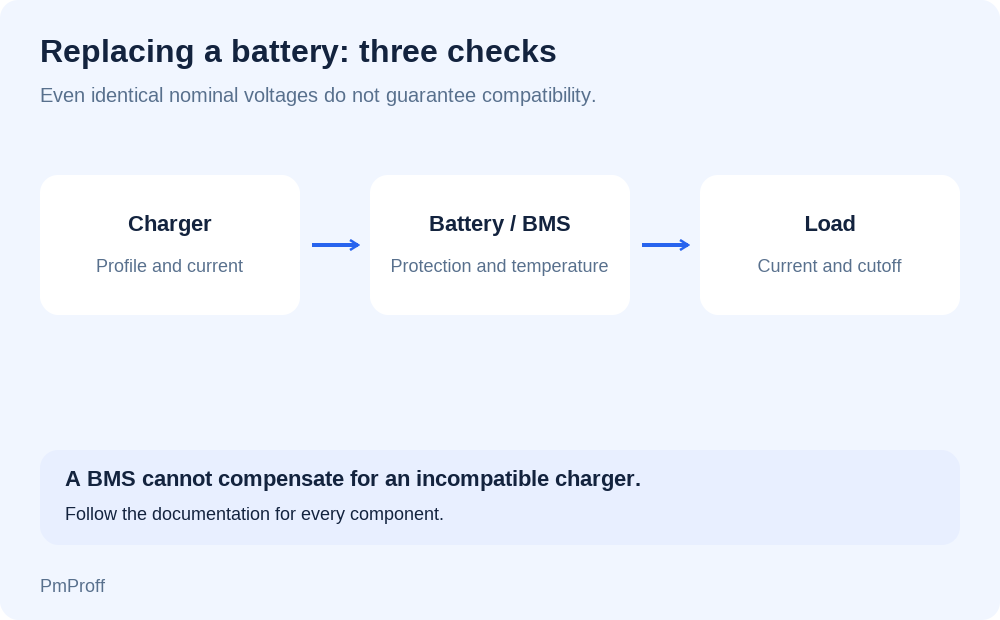
Check the whole system first. Compare charge profile, cutoff voltages, maximum currents and behaviour after a protection trip. A matching connector and “12 V” label alone do not establish compatibility.
A BMS monitors a lithium battery. The charger must still be compatible. Some batteries have a built-in BMS, while others need an external module. For example, Victron Lithium Smart documentation covers BMS selection and its interaction with chargers separately. System design and BMS selection.
Charging and discharging temperatures
A battery may have different temperature ranges for operation, charging and storage. A model that can supply a load below freezing may still prohibit charging at the same temperature.
For LiFePO4, check protection against low-temperature charging and whether heating is available if needed. Use the limits for the particular battery. Example of separate operating limits in the Victron manual.
Series or parallel connections require manufacturer approval and suitable protection. Do not combine different chemistries in the same pack. Have a qualified specialist install power circuits.
Six questions before choosing
- Is this an existing system or a new design?
- Which battery types does the charger support?
- How much usable energy is needed between charges?
- What are the maximum running and startup currents?
- At what temperature will the battery charge?
- Are life expectancy, warranty and their conditions specified?
Life, self-discharge and internal resistance
Read a cycle-life rating together with the depth of discharge, temperature and remaining capacity used as the endpoint. Calendar life and cycle count measure different things. Runtime can decline over the years. Check discharge and charging temperature limits separately.
Self-discharge is the loss of charge during storage. It may be quoted as a percentage per month at a given temperature. Load current is measured in amperes. Built-in electronics may draw additional power. Follow the manufacturer’s storage instructions before storing the battery for an extended period.
Internal resistance is measured in milliohms using a defined method. Higher resistance can mean a larger voltage drop under load, but a single reading does not determine remaining capacity. Compare identical models under the same conditions using the instrument’s specified method. Hioki discusses state of charge and temperature during testing.
Connections, terminals and replaceable cells
A series connection adds voltages. A parallel connection can increase available capacity. Follow the manufacturer’s restrictions: some battery management systems prohibit particular arrangements or limit the number of modules. Victron explains connections and cable resistance. Do not use this rule to assemble a high-voltage string yourself. A 192 V battery input, for example, is incompatible with a single 12 V battery.
Terminal type determines the mechanical connection. Blade terminals, bolted connections and threads must fit the cable and equipment. Matching voltage does not compensate for incompatible terminals. Nominal voltage is a reference rating. Actual voltage changes with state of charge.
CR123A and CR2 are primary lithium cell sizes. Do not charge these cells or automatically substitute similar-sized rechargeable cells. Voltage and permitted use may differ. Match cell size and chemistry to the device requirements. Panasonic lists dimensions and voltages for these lithium cells.
Frequently asked questions
Is GEL always better than AGM?
No. Compare specific models for the duty cycle, current, service life and charging requirements. The technology name alone cannot determine which suits every application.
Can I connect LiFePO4 to any UPS?
No. Verify the charge profile, protection features and operating modes. An integrated BMS alone does not establish compatibility.
Which matters more: price or cycle count?
Compare total system cost against usable energy and the expected duty cycle. A high cycle-life rating has little value if the battery is incompatible or cannot recharge in time.
Choose a compatible system for your use case. Compare service life under equivalent conditions and verify charging compatibility before changing batteries.