
Specifications and technology / Video surveillance
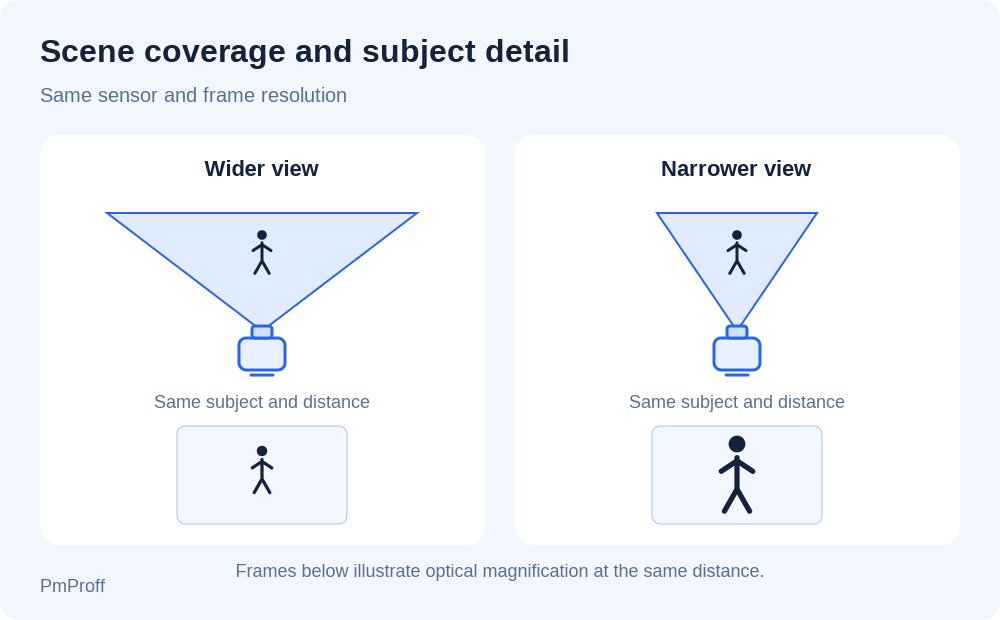
With the same sensor, a shorter focal length generally gives a wider view and a longer focal length gives a narrower one. A 2.8 mm camera and a 3.6 mm camera can serve different purposes. Neither focal length is inherently better.
A yard may require an overview, while an entrance needs detail in a specific area. Decide what you need to see in the recording and at what distance.
What the millimetres on a lens mean
2.8 mm, 3.6 mm and 2.8–12 mm describe focal length or a range of focal lengths. Observation distance and infrared illumination range are separate specifications.
The angle of view also depends on sensor size and imaging mode. When comparing cameras, find the actual horizontal and vertical angles in degrees. Equal focal lengths do not guarantee equal framing. Axis on lenses and field of view.
| Parameter | What it describes | Distinguish it from |
|---|---|---|
| Focal length, mm | An optical property related to image scale | Observation distance |
| Angle of view, ° | Horizontal, vertical or diagonal angular coverage | Image resolution |
| IR range, m | Rated illumination distance under stated conditions | Guaranteed identification of a person |
Choosing between 2.8 and 3.6 mm
Measure the distance from the mounting point to the target area and the width of that area. Check the model’s angle of view or use the manufacturer’s lens calculator. A “90 degrees” figure for one lens does not apply to every camera with the same focal length.
At an entrance, frame the area of interest and minimise empty wall or sky. A wide frame suits a yard overview, but distant subjects occupy fewer pixels. Two cameras with distinct roles can work better than one with an excessively wide view.
How viewing angle determines scene width
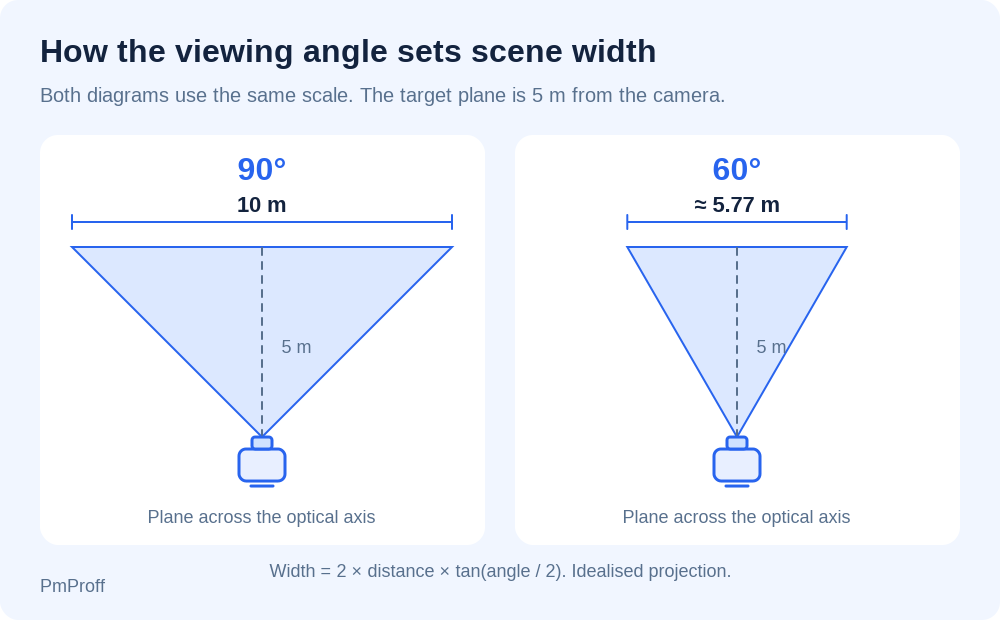
For an ideal rectilinear projection, the width at a plane perpendicular to the optical axis is approximately 2 × distance × tan(angle / 2). At 5 m and a 90° horizontal angle, the width is 10 m. At 60°, it is about 5.77 m.
This is a geometric example. Camera tilt, distortion, digital correction and cropping can affect the result. Check the final framing at the installation site.
Fixed, varifocal and motorised lenses
A fixed lens has one focal length. A varifocal lens lets you frame the scene within a specified focal range. A motorised mechanism can simplify remote zoom and focus adjustment if the camera supports it.
A motorised lens does not mean the housing can pan left or right. Pan and tilt are separate PTZ capabilities. Some varifocal lenses are designed primarily for setup. Check whether the model supports frequent zoom changes during operation. Axis on lens types and adjustment.
When a wider view loses useful detail
Consider a frame 1920 pixels wide. At a plane 10 m wide, it gives 192 pixels per metre. At 5 m wide, it gives 384. This estimates pixel distribution. It cannot guarantee recognition of a face or licence plate.
Light, shutter speed, motion and subject position also matter. Check recordings in the expected night conditions as well as live video during the day. Define the observation task before planning coverage, as explained by Axis in its guide to lens calculation and pixel density.
“IR 30 m” does not promise recognition of a person at 30 m. Check light, subject size in the frame and recording conditions.
Checks before installation
- Define the task: an overview, distinguishing actions or seeing details in a specific area.
- Measure the distance, area width and mounting height.
- Look up the actual camera’s horizontal angle of view.
- Check the available focus and zoom adjustments.
- Make test recordings by day and by night.
- Inspect the relevant subject in the recording as well as the overall framing.
Frequently asked questions
Does a 2.8 mm camera see farther than a 3.6 mm camera?
These figures describe focal length. With the same sensor, 2.8 mm usually gives a wider frame and 3.6 mm a narrower one. Assess detail at the distance you actually need.
Can digital zoom replace a longer lens?
No. Enlarging a recorded frame cannot add missing detail. A lens changes image scale at the sensor before recording.
Is a varifocal camera better everywhere?
It offers more framing flexibility. For a known target area, a suitable fixed lens may be sufficient.
Choose a lens for the target area and distance. Compare focal length together with sensor size and actual angle of view, then verify the result in recorded footage.