
Specifications and technology / Networking
dBi expresses antenna gain relative to a theoretical isotropic antenna. It does not specify transmitter power, internet speed or coverage in metres.
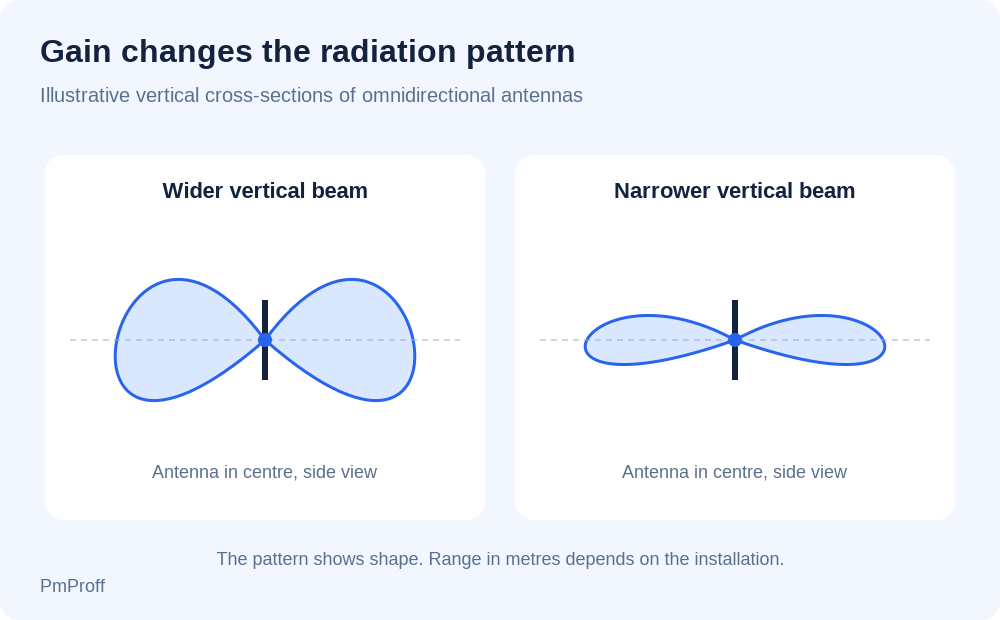
A passive antenna does not create energy. It distributes radiation differently by direction. Higher gain in one direction may come with a narrower pattern in another plane.
What antenna gain means
An isotropic source is an ideal reference that radiates equally in all directions. A real antenna has its own radiation pattern. Gain in dBi compares it with that reference, usually in the direction of maximum radiation.
An omnidirectional antenna may provide wide coverage around its axis, but its coverage varies with elevation. As gain increases, the vertical pattern often narrows. See Cisco’s comparison of omnidirectional and directional antennas.
dBi, dBm and dB measure different things
| Symbol | What it describes | Typical example |
|---|---|---|
| dBi | Gain relative to an isotropic reference | Antenna specification |
| dBm | Power level relative to 1 mW | Transmitter power or received signal power |
| dB | Ratio between quantities | Cable loss |
You cannot add dBi to throughput in Mbps. For a simplified radiated power calculation, add transmitter power in dBm to antenna gain in dBi and subtract feedline losses in dB. Permitted configurations depend on the equipment, frequency and applicable requirements. For basic radio concepts, see Wireless RF Reference Guide Cisco.
Why higher gain does not always improve home coverage
A pattern that suits clients on the same floor may provide little benefit on the floor above the router if it concentrates radiation near the horizon. Antenna orientation and device position determine which areas receive a stronger or weaker signal.
An antenna change alone may do little for a concrete wall. Moving the access point or adding a wired access point may be more effective. For coverage across several rooms, compare mesh and access point options.
Check specifications at the frequency you use
Gain and beamwidth can vary by band. For example, the AIR-ANT2547V-N specification lists separate figures for 2.4 and 5 GHz. Similarly, for a mobile router, check the required LTE/5G bands rather than relying on the largest number on the box.
An external coaxial cable introduces loss. A long run can reduce the benefit of the antenna, especially at higher frequencies. Check the cable type, length, specifications and connectors together. Connectors that look alike can differ electrically or mechanically.
The link works in both directions
The client must both receive from the access point and transmit back to it. Both endpoints’ antennas and transmit power, interference and placement affect the result. A peak signal reading on one device tests only part of the link.
Use antennas compatible with the equipment and permitted operating modes. Manufacturers may list external antenna and radiated power requirements separately, as in the Teltonika documentation. Check the limits before changing transmit power.
What to compare before replacing an antenna
- Required frequencies and the radiation pattern at each one.
- Polarisation, orientation and client locations.
- Connectors, number of connections and MIMO requirements.
- Cable loss and outdoor mounting conditions.
- Speed, latency and stability before and after the change.
Internal, external and detachable antennas
An external antenna can be fixed, and a detachable antenna accepts only compatible replacements. Check the band, connector and purpose of the radio chain. A mobile router may use separate antennas for 4G and Wi-Fi. Check their assignments even if they look alike. Antenna count does not directly multiply speed. For a Wi-Fi bridge, directionality and alignment at both ends also matter.
Frequently asked questions
Is an 8 dBi antenna twice as good as a 4 dBi antenna?
No. Gain is expressed on a logarithmic scale. Suitability depends on the pattern, frequency and intended coverage. These figures do not imply twice the coverage.
Does omnidirectional mean equal signal in every direction?
It usually refers to coverage around the antenna’s axis. The signal can vary substantially with elevation. Check the vertical pattern.
Will an external antenna help with an overloaded mobile network?
It can change reception conditions, but it cannot add spare capacity at the base station. Distinguish poor reception from network congestion.
In brief
Choose a compatible radiation pattern for the area you need to cover. Consider frequency, cable, orientation and both ends of the link alongside the dBi figure.