
Specifications and technology / Intruder alarms
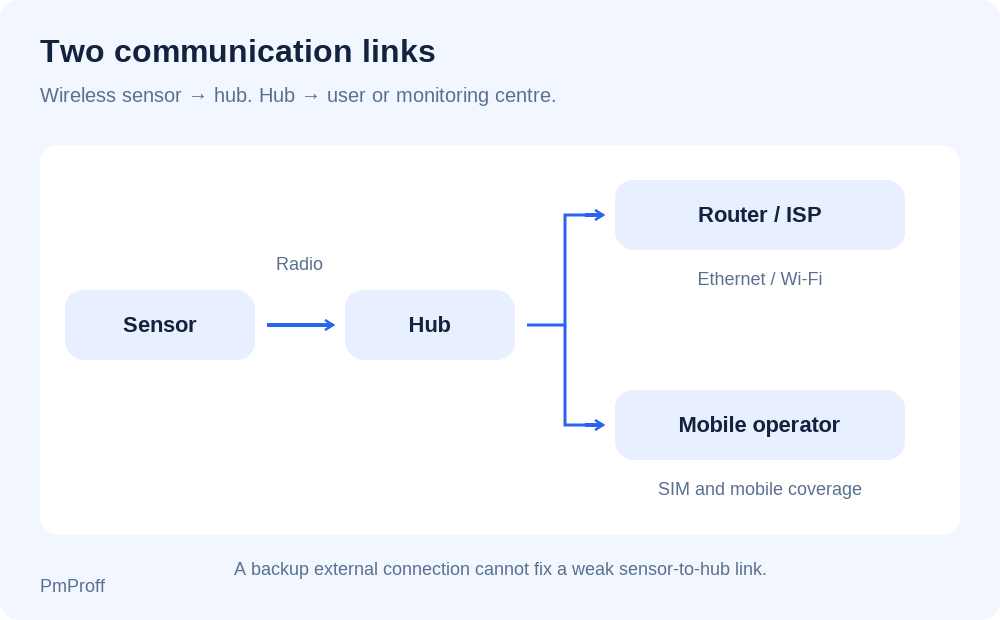
An alarm system has at least two separate paths: the detector sends the event to the hub, and the hub notifies a user or monitoring service. A long-range detector link does not provide a backup for the hub’s external connection. Two SIM cards cannot compensate for a weak detector link either.
Rated range and actual buildings
Manufacturers often quote maximum range in open space. Walls, floors, metal and mounting positions change the radio conditions. Test the link at the final location with doors closed and nearby equipment in its normal position. A successful test in the corridor beside the hub does not establish coverage in the basement.
How to assess the signal
Look for stable communication over time. A single successful transmission tells you little. Ajax provides separate detection zone and radio signal tests. An additional attenuation test helps assess signal margin on supported devices. Use the acceptance criteria in your system’s manual.
| Link | What determines reliability |
|---|---|
| Detector → hub | Protocol, obstructions and signal |
| Hub → internet | Available channels and service availability |
| Backup | Independence from common failures |
| Power | Backup runtime of every required device |
What Ethernet, Wi-Fi and SIM mean
These are external communication options for the hub. They do not identify detector types. For example, Hub 2 Plus uses Ethernet, Wi-Fi and two SIM cards. A similarly named hub may have a different set of connections. Check the mobile network generations, coverage, account balance and service plan.
A backup must survive the same outage
Ethernet and Wi-Fi going through one router depend on the same power supply and ISP. Both can fail together. List each path’s dependencies: mains power, router, operator, antenna and account. Channels that share a point of failure offer less redundancy than independent paths.
How to test the complete system
Notify the monitoring service in advance if the system reports to a monitoring centre. Test delivery of an event under normal conditions, then under agreed failure scenarios. Test backup power for the hub and network equipment separately. Afterwards, confirm that all connections have recovered and no fault notifications remain unresolved.
Checks before choosing
- Test signal at the final locations.
- Identify dependencies shared by multiple channels.
- Test event delivery and connection recovery.
Two SIM cards in an alarm panel
Dual SIM in an alarm panel usually provides operator failover. It generally does not double speed or provide simultaneous transmission through two modems. Check supported mobile network generations, failover order, active service plans and each operator’s coverage. Two SIMs from the same operator may depend on the same base station.
SIM count does not tell you how many independent paths are available. Assess Ethernet, Wi-Fi and cellular separately. The Ajax Hub 2 specifications list cellular capabilities by model version. Check alarm delivery after disconnecting the primary path and measure recovery time. Avoid disabling every channel at once on an operational site.
Protocol, encryption and system capacity
Frequency alone does not establish compatibility. The devices must support the required protocol, version and regional variant. Ajax describes Jeweller as its proprietary two-way protocol. Depending on the device, Wings may carry other data. For example, LifeQuality uses it to transmit stored measurements. Protocols using the same frequency are not necessarily compatible.
An AES specification identifies an encryption algorithm. Overall protection also depends on device authentication, key management and configuration. A wireless device count may be a limit for a hub, repeater or subsystem. These figures cannot necessarily be added together as extra slots. Before expanding, check the exact model limits and version compatibility.
Ethernet, Wi-Fi and 2G/3G/4G describe the panel’s external connections. “Optional” may mean that a separate module is required. The internal radio link to a detector is a separate path. If the catalogue is ambiguous, consult the model’s data sheet.
Frequently asked questions
Will a detector rated for 2 km work through any walls?
No. The rated range does not describe propagation through every possible building.
Do two SIM cards guarantee connectivity?
No. Both coverage and active service plans are needed, and the hub itself must work.
Does a repeater add a cellular connection?
It usually extends the link between devices and the alarm system. Check the capabilities of the exact model.
In brief
Test both paths and their dependencies: from detector to hub and from hub to the event recipient.