
Specifications and technology / Solar power
An MPPT controller selects the operating point of a solar array to harvest energy. It can only work with panels that meet its requirements. The absolute input voltage limit, operating voltage range and allowable current are separate constraints. Exceeding the voltage limit is quite different from the controller limiting power.
Voc, Vmp and the MPPT range
Voc is open-circuit voltage. Vmp is the voltage at the maximum power point under the stated conditions. The MPPT operating range describes the voltages over which the controller can track that point. There may also be a separate startup voltage. If the data sheet lists several values, describing the input simply as “up to 100 V” loses important information.
Why cold weather matters
A panel’s open-circuit voltage rises as its temperature falls. Victron warns that PV voltage must stay within the controller’s limit even in cold conditions. Use the panel’s voltage temperature coefficient and the minimum design temperature in the calculation. The nameplate Voc at standard test conditions alone is insufficient.
| Parameter | What to match |
|---|---|
| Voc | Cold-weather maximum against the absolute input limit |
| Vmp | MPPT operating range |
| Current / Isc | Limits for the individual input |
| Power | Configurations approved by the manufacturer |
Series and parallel connections change different quantities
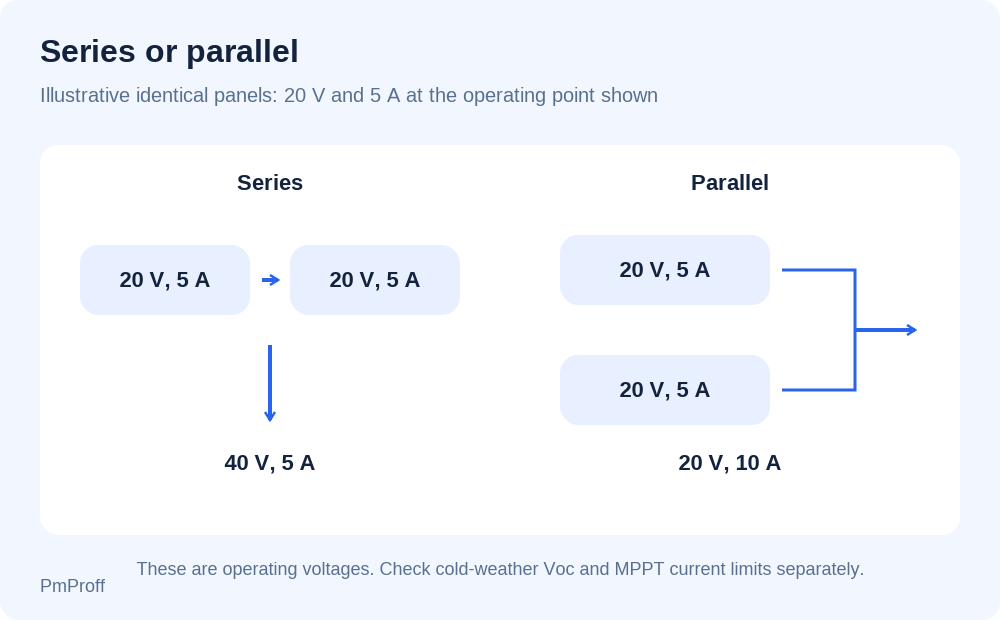
With identical panels, connecting them in series adds their voltages. Connecting them in parallel adds their currents. The diagram illustrates this relationship only. An installation design also accounts for the number of MPPT trackers, short-circuit current, protection, connectors and uneven illumination. Check the configuration against the specific inverter.
Why a “500 W” rating alone cannot establish compatibility
Two panels with the same power rating may have different voltages and currents. An inverter data sheet lists PV limits separately, as shown in the EasySolar-II GX specifications. A manufacturer may allow an array to exceed nominal PV power. This allowance does not extend to Voc or any other absolute limit.
What your installer needs to know
Provide the exact panel and inverter models, panel count, expected temperatures and planned string configuration. Ask the installer to check the operating range, cold-weather Voc and current limits for each input. An illuminated solar array can remain at hazardous voltage. Leave installation and measurements to a qualified professional.
Checks before choosing
- Obtain the data sheets for both components.
- Check cold-weather Voc and current for each input.
- Agree on the configuration and protection with a qualified installer.
Frequently asked questions
Will MPPT bring any excess voltage down to a safe level?
No. Exceeding the absolute input voltage limit can damage the device.
Is a lower-power panel always suitable?
No. Check voltage and current separately.
Do two inputs mean two independent MPPT trackers?
Not necessarily. Check the wiring diagram and specifications for the specific inverter.
In brief
Panel wattage is only one part of the check. Voc, operating voltage and current must also satisfy the input requirements.