
Specifications and technology / Network equipment
“6 kV lightning protection” on a switch does not mean it will survive a direct lightning strike. The rating usually describes immunity to a defined test impulse. Compare numbers only with their test methods and conditions.
Voltage alone does not describe a surge
Waveform, duration, source, coupling method and the pass criterion all matter. Equal kV ratings under different conditions do not establish equal immunity. Texas Instruments’ guidance on Ethernet EMC covers different tests and ways of coupling interference. Surge immunity is separate from a port’s allowed operating voltage. A surge rating does not permit continuous high voltage on that port.
Common-mode and differential-mode tests
In a common-mode test the impulse is applied relative to earth. In a differential-mode test it is applied between conductors. A rating of “4 kV common mode / 2 kV differential mode” therefore describes two different tests. TI’s application report on PoE protection emphasises the way the surge is applied. To compare devices, ask for the standard, test configuration and verified level. Without them, a higher catalogue figure is an inadequate basis for selection.
| Listed rating | What to check |
|---|---|
| 2/4/6 kV | Standard and impulse waveform |
| Common mode / differential mode | Points between which the impulse is applied |
| PoE protection | Compatible standard and power level |
| Outdoor installation | Enclosure, earthing and cable route |
Built-in protection and an external surge protector
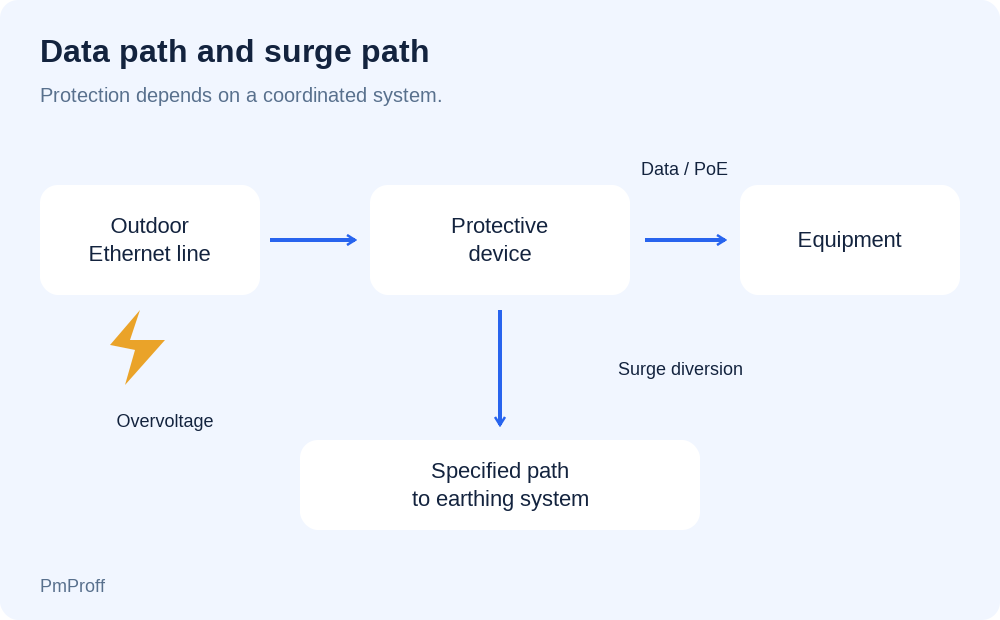
A port’s own immunity and a separate protector are different layers. An external protector must suit the Ethernet speed, PoE type, installation environment and earthing arrangement. Axis describes Ethernet surge protectors as devices that divert a surge to earth while allowing data and power to pass. Select the protector and its position for the installation. An incompatible device can limit throughput or interfere with power delivery. Check the data sheets for the protector and connected equipment.
Why the cable route matters
An outdoor run, a long link or proximity to power cables changes the risk. Shielding works as part of a coordinated system. A shielded jacket alone cannot provide the whole protection scheme. Axis’s surge protection guide covers earthing and cable routing. Never substitute an arbitrary metal structure for the specified protective connection. Have a specialist review links between buildings, on poles and on external walls. Fibre can be appropriate in some cases, although the power supply and equipment at either end still require their own protection.
What to look for in a specification
Record the exact model, port, test mode and installation conditions. Check whether the rating applies to all Ethernet ports, the power input or another interface. After a surge, check more than link status. PoE delivery, transmission stability or the protective element itself may be affected. Follow the manufacturer’s inspection and replacement procedure. A stated immunity level reduces specific risks. The site still requires a coordinated protection system.
Checks before choosing
- Find the test method as well as the kV rating.
- Check Ethernet and PoE compatibility at both ends.
- Check earthing and mounting requirements.
- Have the entire route of an outdoor line assessed.
Frequently asked questions
Does 6 kV mean protection against a direct lightning strike?
No. The port rating does not support that conclusion.
Can I compare 4 kV ratings from different manufacturers?
Only if the test conditions are known and comparable.
Can shielded cable replace a surge protector?
No. Cable, earthing and surge protection perform different functions within the same system.
In brief
Evaluate the test method and the full surge path. A kV figure alone cannot establish that a network is adequately protected.