
Specifications and technology / Sensors
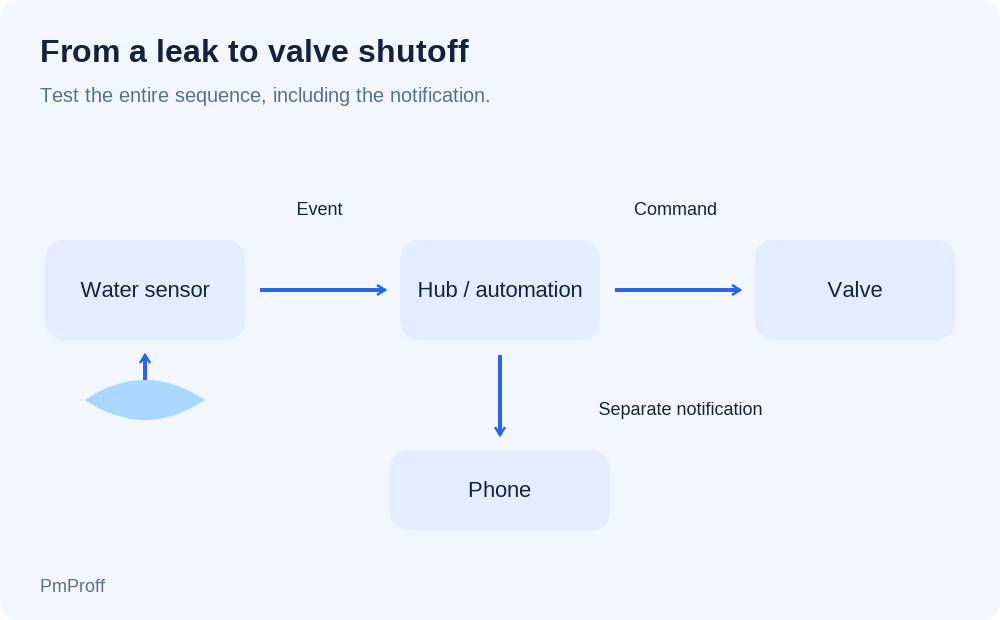
A leak detector reports water at its location. It cannot shut off the pipe on its own. Automatic protection requires a compatible actuator, a configured automation rule and a verified communication path between them.
What the detector senses
In a contact-type detector, water bridges the sensing contacts. For example, the LeaksProtect manual describes contact pairs on the underside of the housing and event transmission to a hub. This detector measures neither flow nor pipe pressure. Water must reach its sensing area: a detector on a dry shelf cannot detect a puddle under a washing machine. For other designs, including remote sensing cables, follow their documentation.
Placement determines how quickly a leak is detected
Inspect possible leak sources such as hose connections, filters, water heaters and drain traps. Consider slopes, thresholds and obstructions that change where water flows. One sensor does not automatically cover a whole room. Allow access for inspection, cleaning and battery replacement. Check radio reception at the actual mounting point, particularly behind metal enclosures.
| Component | What to verify |
|---|---|
| Sensor | Water reaches the contacts |
| Communication | The event reaches the system |
| Scenario | The correct valve receives the command |
| Valve | Water flow actually stops |
From notification to shutoff
The chain consists of the detector, control system and a compatible shutoff valve or tap. Ajax’s example of automatic water shutoff shows separate setup for the actuator and the automation rule. Have a qualified installer check plumbing compatibility, direction of flow and emergency operation. Voltage alone is insufficient for valve selection. A phone notification does not confirm that water flow has stopped.
Testing without damaging equipment
Follow the sensor’s test instructions and keep electrical appliances dry. Verify the event, its intended recipients and the valve’s actual position. Dry the contacts afterwards and confirm that the system returns to normal. Agree on who may reopen the water supply: automatic reopening when the contacts dry may be undesirable. Also check what happens during loss of power, loss of communication or a depleted battery.
Checks before choosing
- Trace the likely route of a leak.
- Check signal strength at the installation point.
- Test shutoff and manual restoration.
- Schedule contact and battery checks.
Frequently asked questions
Does the detector turn off the water by itself?
No. It requires a compatible actuator and automation rule.
Is one detector enough for an apartment?
That depends on the location of possible leaks and the route water takes, as well as floor area.
Does a notification guarantee there will be no damage?
No. Water can escape before detection and shutoff, and backup arrangements have limits.
In brief
Plan both the route water takes and the path of the shutoff command. Verify actual valve operation rather than relying on an automation label.