
Specifications and technology / Sensors
An acoustic detector listens for characteristic sounds. Its coverage depends on distance, the sound path, microphone position and the conditions under which the manufacturer tested the algorithm.
A microphone senses the sound
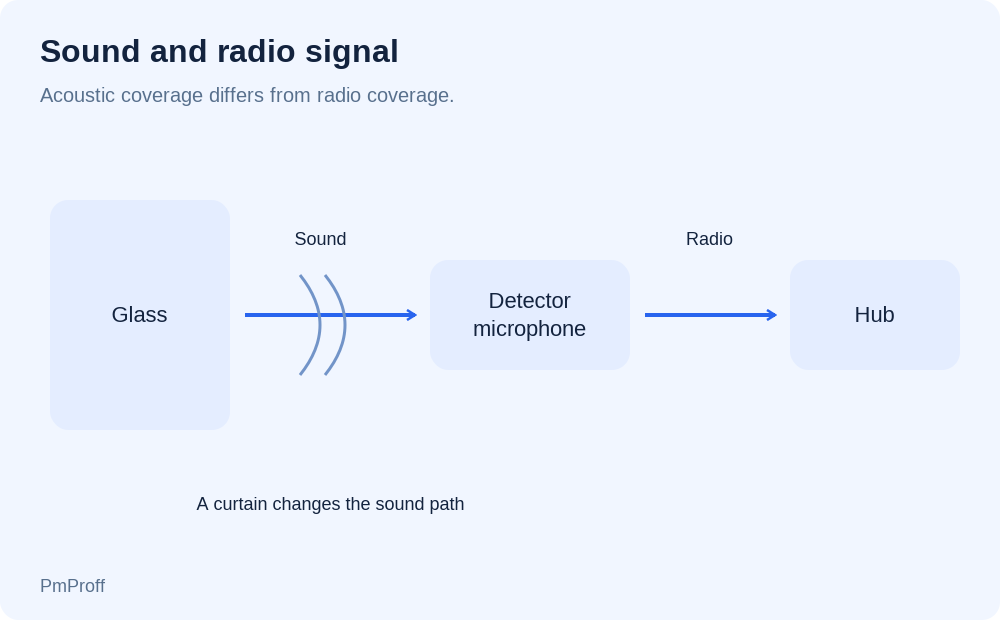
An electret microphone is the sensing element in an acoustic detector. For example, the GlassProtect quick guide describes analysis of a low-frequency impact and the high-frequency sound of glass fragments. Other detectors may use different algorithms. A 180° rating does not guarantee detection at every pane in a semicircle regardless of obstructions.
Curtains and furniture change the sound path
Keep the microphone clear and account for objects between the detector and the glass. Repeat checks after furnishing the room and hanging curtains. Mark every window requiring coverage on the plan. An open doorway alone does not establish coverage of the next room. Use the rated range together with the orientation and glass-type requirements.
| Parameter | Distinct from |
|---|---|
| Detection angle | Guaranteed detection through obstacles |
| Range | Total floor area of the site |
| Acoustic sensor | Reed switch or PIR |
| Alarm test | Radio link test |
Glass breakage, opening and impact
A reed switch responds to a change in magnet position, a shock sensor to mechanical disturbance and an acoustic channel to sound. Opening an intact window may produce no glass break sound. For combined detectors, evaluate each channel separately. The full GlassProtect manual describes setup and testing for that acoustic model. For opening detectors, see the separate guide to reed switches and accelerometers.
Acceptance testing
Use the manufacturer’s specified method or a compatible tester. Do not break glass to test the detector. A random phone recording cannot verify performance for every model. Test each required window, alarm delivery and return to normal operation. Check the radio signal separately. Good acoustic coverage does not guarantee communication with the hub. Repeat the test after changing curtains, partitions or detector position.
Checks before choosing
- Check the glass type against the manual.
- Check the sound path and detector orientation.
- Use the recommended test.
- Retest after changes to the room.
Frequently asked questions
Will an acoustic detector detect a window opening?
Not necessarily. This usually requires a separate opening detection channel.
Can I test it with any sound played on a phone?
Only use phone playback if the manufacturer explicitly permits that method.
Does 180° mean there are no blind spots?
No. Geometry and obstructions still matter.
In brief
Evaluate the sound path, glass type and test method alongside the rated distance and angle.