
Specifications and technology / Cables
Choose a cable for the signal, load and environment. A similar outside diameter or the word “video” does not make different cable designs interchangeable. Start by identifying what each conductor carries.
Coaxial cable and twisted pair
Coaxial cable has a centre conductor, dielectric and outer conductive shield. Twisted-pair cable contains pairs of conductors twisted together. For a video link, check characteristic impedance, attenuation, frequency range and connector compatibility. Belden’s coaxial cable catalogue lists different applications and specifications for each series. For Ethernet, see the separate guide to Cat5e and Cat6.
What is a combination cable?
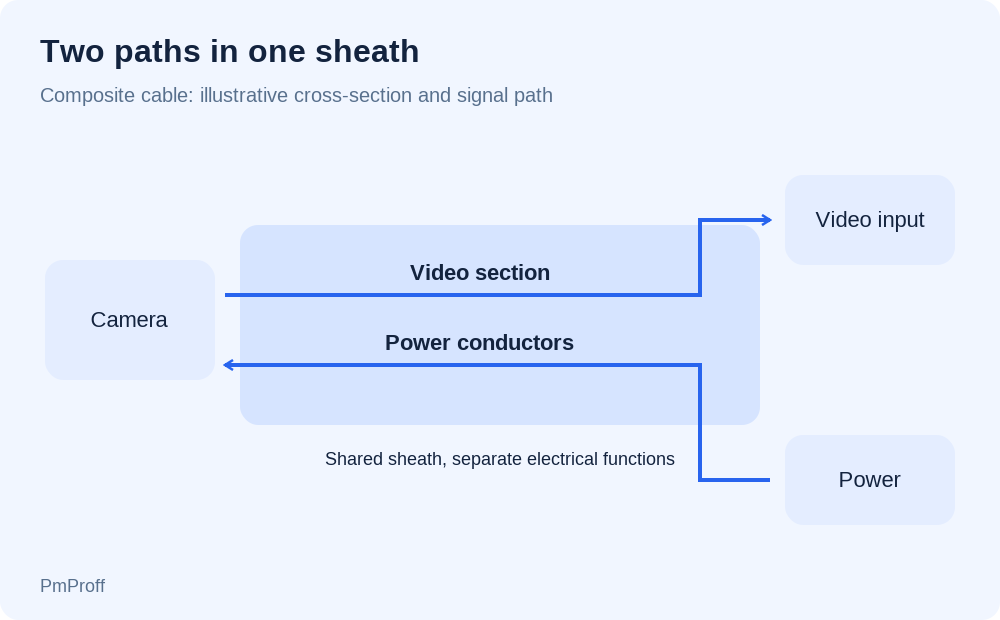
A single cable can contain a video section and separate power conductors. This allows them to share a route but does not make the cable Ethernet or PoE. Check the video signal against the camera and receiver requirements. For power, check current rating, conductor cross-section and voltage drop. If a camera shows a picture by day but restarts at night, check its supply with the illuminator running as well as the video connection.
| Type | What to check |
|---|---|
| Coaxial | Impedance, attenuation, shield and connectors |
| Signal | Conductors, cross-section, resistance and application |
| Combination | Check signal and power separately |
| Twisted pair | Category and Ethernet requirements |
Signal cables serve different applications
Match conductor count, cross-section, conductor material, shielding and sheath to the system. A detector circuit, data interface and power feed may each have different limits. Follow the manufacturer’s specification rather than assuming any two wires will do. Pay particular attention to maximum loop resistance, length, installation conditions and fire alarm system requirements. A cable shield is not automatically a protective earth conductor.
Read RG-59 and other designations with the data sheet
A family name does not specify every property of a cable. For example, Belden 4505R has separate specifications for materials, dimensions and electrical characteristics. For supplier designations such as RG-660C, RG-690CU or SL-59, check the original manufacturer’s documentation. Suffixes can have different meanings across brands. On long runs, compare attenuation at the required frequency as well as price per metre.
Checking the cable run before closing the walls
Confirm length, connectors, fixing method, permitted bend radius and installation environment. Outdoor sections need an appropriate sheath and protected connections. Test the finished video and power arrangement with all required functions active. Label both ends and keep a route drawing. A successful test on a short cable cannot establish performance over the full run. Work near power lines and fire alarm systems must follow the design.
Checks before choosing
- Identify the signal type and power requirements.
- Find the data sheet for the exact cable.
- Test the intended operating mode at full length.
- Keep end labels and a drawing of the route.
Frequently asked questions
Does a combination cable provide PoE?
No. These carry signals and power in different ways.
Are all RG-59 cables the same?
No. Materials and specifications can differ among products.
Does a thicker sheath guarantee a better connection?
No. Check the electrical specifications and suitability for the environment.
In brief
Check signal, power and installation separately. A cable designation helps narrow the choice, but compatibility requires the actual specifications.