
Specifications and technology / Networking
Cat5e, Cat6 and Cat6A describe cable category. U/UTP and F/UTP describe shielding. Shielding alone does not increase speed. Even a high-category cable needs the correct connectors and installation.
Choose the whole channel from port to device, including permanent cable, outlets, patch panel and patch cords. A poorly terminated connection can limit an otherwise high-quality run.
What cable category means
Category sets requirements for the electrical performance of the cabling system. Internet plan speed and file transfer throughput are separate measures. Cat5e is widely used for gigabit links. Cat6 has different requirements and performance headroom. Cat6A supports applications including 10GBASE-T on a standard 100-metre channel. Using 10G over Cat6 is subject to length and installation limits that differ from Cat6A. Fluke Networks comparison of cabling categories and network standards.
Check the ports before replacing cable. Cat6A cannot turn a 100 Mbps port into a gigabit one. For a move to 2.5G, the existing run may only need verification. For end-to-end limits, see the guide to LAN port speeds.
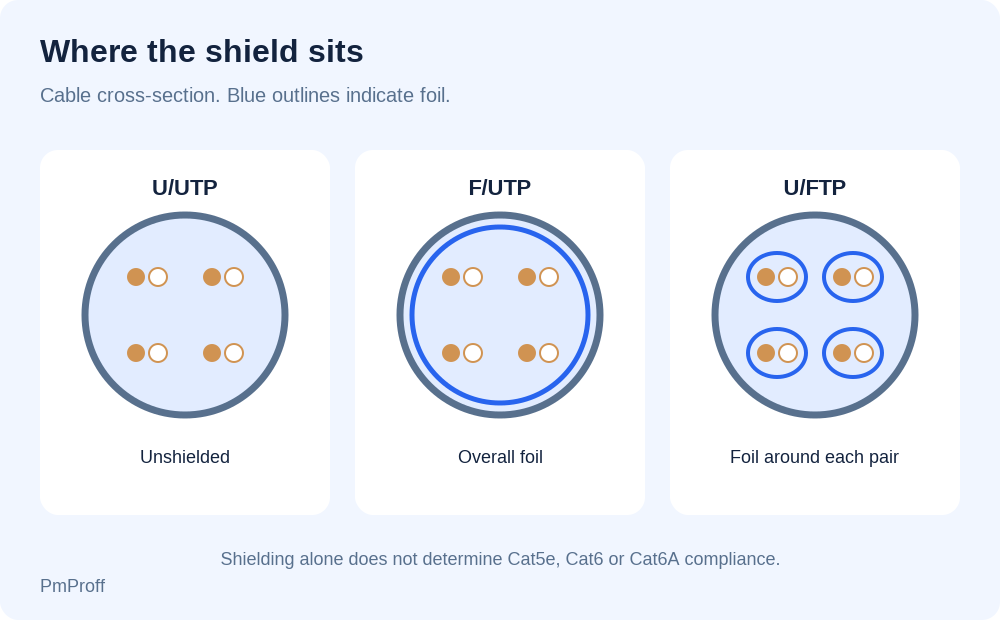
Reading U/UTP, F/UTP and U/FTP
| Symbol | Overall shield | Individual pair shields |
|---|---|---|
| U/UTP | None | None |
| F/UTP | Foil around all pairs | None |
| U/FTP | None | Foil around each pair |
| S/FTP | Braid | Foil around each pair |
The part before the slash describes overall shielding. The part after it describes the pairs. UTP and FTP are common shorthand, but use the full designation when ordering. Belden explains shielding types.
When is shielding needed?
Shielding is a design choice. It requires compatible connectors, shield continuity and correct equipotential bonding under the applicable installation rules. Never improvise an earth connection or bond the shield to an arbitrary metal structure.
An office run may need a different design from one beside industrial equipment. Plan separation from power cables and check site requirements. Shielding cannot compensate for poor termination or incorrect pairing.
Copper versus CCA
CCA is copper-clad aluminium. Its higher resistance and potential failure to meet claimed specifications can be particularly problematic for PoE. Check whether the cable is solid copper or CCA. Fluke Networks describes the risks of CCA and resistance unbalance.
Check the data sheet, markings and cable provenance. Conductor surface colour and reel price alone are unreliable guides. Permanent cable and flexible patch cords can have different conductor constructions. Match the connector to the conductor type and diameter.
Outdoor cable and PoE
Check the jacket’s suitability for sunlight, moisture and temperature independently of category and shielding. Select cable for the actual installation conditions. Belden discusses outdoor cable runs. For PoE, also check length, resistance, connections and heat buildup in bundles.
An outdoor copper link between buildings requires a specific protection and bonding design. Shielding and an “Outdoor” label alone cannot provide that protection.
Checking an installed link
- Verify the category of every component, including the cable.
- Check pair mapping, length and termination quality.
- For a critical network, obtain a test report for the required category.
- Check negotiated speed, errors and device operation under load.
- For PoE, repeat the test with the actual powered device at its maximum operating load.
Conductors, jacket and intended use
Conductor diameter in millimetres differs from cross-sectional area in mm². For a round solid conductor, area equals πd²/4. For a stranded conductor, use the data sheet rather than the outside diameter of the insulation. Four twisted pairs contain eight conductors. A four-conductor signal cable cannot serve as Ethernet cable simply because the wire count looks similar.
Cu means copper, CCA means copper-clad aluminium and CCS means copper-clad steel. Material affects resistance and suitability for carrying power. Fluke Networks explains CCA risks. Read “cable resistance” with its units: conductor resistance in Ω/km and the 75 Ω characteristic impedance of coaxial cable are different quantities.
Choose the jacket and installation method for the environment, UV exposure, moisture and mounting arrangement. A strength member in an aerial cable carries mechanical load. It does not replace an electrical conductor. Check the specific construction marking. LSZH indicates low smoke and zero halogens. Continued operation during a fire requires separate evidence. The Belden data sheet lists jacket properties and tests separately. Fire alarm systems need the cable system class specified by the design. Colour or a “fire-resistant” label alone does not establish compliance.
Frequently asked questions
Is Cat6 always shielded?
No. Category and shielding are independent. Check the full construction designation.
Does continuity on all eight conductors mean the link is sound?
Continuity alone cannot confirm performance at the required frequency. Certification requires the appropriate measurements.
Can cable categories be mixed?
The components may connect physically. Claim performance for the complete channel based on its actual construction and test results, not just its highest-rated component.
In brief
Start with the required speed and installation conditions. Select category, conductor material, shielding and compatible connectors, then test the installed link.