
Specifications and technology / Mobile broadband
A 4G/5G router’s speed depends on more than its LTE category. It needs compatible bands, a capable base station, a good radio link and a sufficiently fast local connection.
Before buying, test the operator at the intended installation point. A coverage map or a phone test in another room tells you only so much.
What does LTE Cat mean?
The LTE category describes a modem’s capabilities, including its speed limits under specified conditions. It does not guarantee the speed you will get on your plan. For example, the Teltonika RUTX09 supports LTE Cat 6 and carrier aggregation, with a stated maximum download speed of 300 Mbps. That figure describes the model. Actual speeds vary with the connection.
Compare upload speeds as well. Video calls, backups and cameras all depend on upload capacity. Devices with similar names may use different modems and have different specifications.
What carrier aggregation does
Carrier aggregation uses several carriers to transmit data. It does not combine SIM cards or add the speeds of two operators. Both the modem and the network must support the particular band combination. See Teltonika’s LTE Cat 6 example.
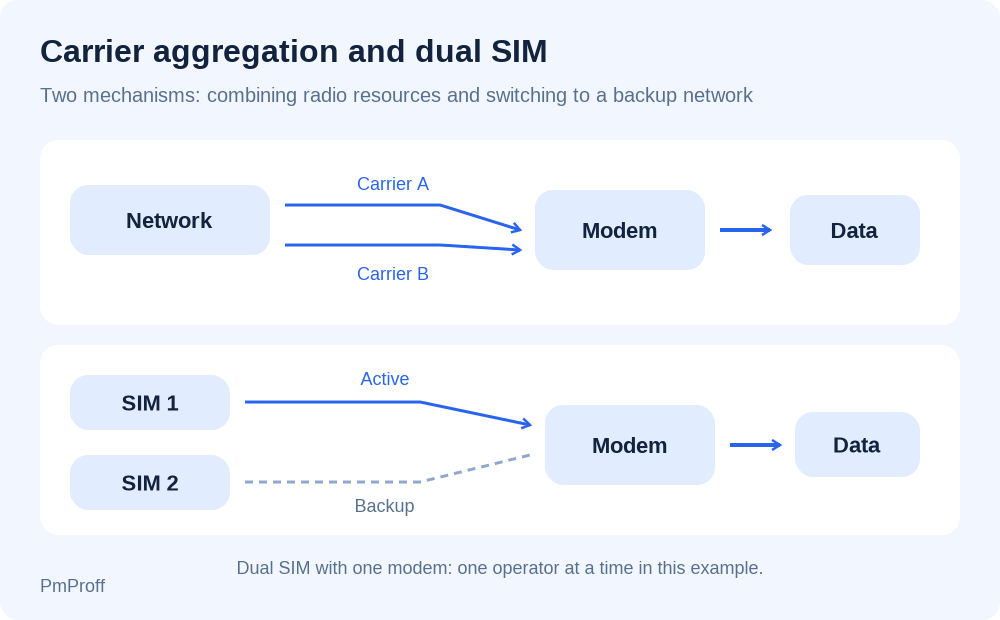
Two models may support the same individual bands but different combinations for aggregation. Check the regional version, modem and manufacturer’s tables. A “4G+” label alone cannot predict the gain at a particular site.
5G, SA and NSA
SA and NSA refer to different 5G network architectures. NSA also relies on LTE infrastructure, while SA uses a standalone 5G architecture. Check which modes and bands the specific regional model supports. For examples of connection status information, including 5G SA/NSA, see the RUTM50 documentation.
A 5G router will not necessarily perform better everywhere. A stable LTE link may be more useful than a weak or congested alternative. Test latency, connection drops and throughput at the times you expect to use the network.
Why signal bars are not enough
| Metric | What it helps you assess | What it cannot establish |
|---|---|---|
| RSRP | Reference signal power | Spare capacity at the base station |
| RSRQ | Reception quality under the current channel conditions | Guaranteed throughput |
| SINR | Ratio of useful signal to interference and noise | Whether other bottlenecks exist |
Consider these metrics alongside actual tests. Avoid applying a single set of thresholds from an unrelated table to every modem and radio technology. Teltonika explains signal strength and signal quality.
Antennas and installation location
First try several positions with the same equipment and a short Ethernet test. Thick walls, metal and an enclosed cabinet affect reception. When selecting an external antenna, check the bands, connectors, number of MIMO connections and cable loss. A higher gain figure does not guarantee a better result.
After moving the router, compare sustained connection stability as well as the highest speed-test result. Check the LAN ports and Wi-Fi, so that you can distinguish a local bottleneck from a mobile network limitation.
Dual SIM often provides failover on one modem. Running two independent mobile connections simultaneously requires suitable hardware and software support for that mode.
Checks before buying
- Confirm the regional version, bands and carrier aggregation combinations.
- Test the operator on site, preferably at different times of day.
- Compare measured download speed, upload speed and latency with your requirements.
- Check the router’s ports, power supply and operating conditions.
- If you need backup connectivity, check exactly how SIM failover works.
- For remote access, check the operator’s IP addressing policy and how you will establish a secure connection.
Frequently asked questions
Is Cat 6 always twice as fast as Cat 4?
No. The ratio between theoretical maxima does not carry over directly to a live network. Available resources and reception conditions determine the result.
Will two SIMs increase speed?
Two SIMs alone will not. Failover, load balancing and bonding are separate functions. Check how many modems the device has and which functions its software supports.
Why is my phone faster than my router?
They may use different modems, antennas, bands or aggregation combinations. Compare them in the same location and account for how the client connects to the router.
In brief
Choose a router for the operator and the installation site. Its LTE category, aggregation support, bands, antennas and local ports all have to work together.