
Specifications and technology / Perimeter protection
An active infrared barrier monitors the line between a transmitter and receiver. It emits beams and detects interruption according to configured rules. Its coverage differs from the area in front of a PIR detector.
What the pair monitors
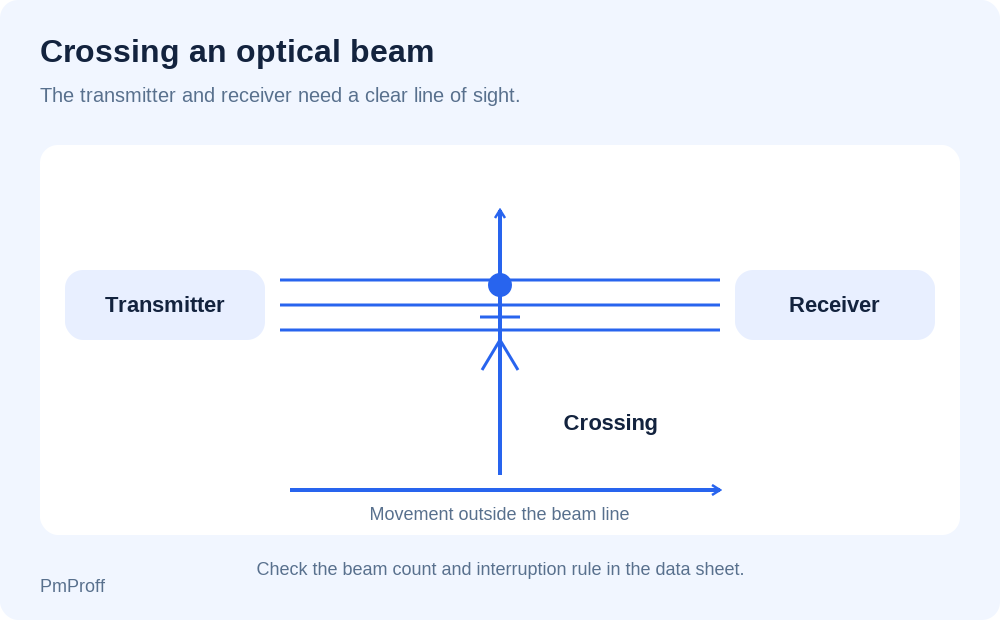
Position the transmitter and receiver so that they have a stable optical path. A person crossing this path interrupts the beams. Movement outside the path may produce no event. Optex describes active beams as a point-to-point link, so plan their geometry around the route the installation needs to monitor.
Why use several beams?
The beam count and interruption rule depend on the model. Check whether beams must be interrupted simultaneously, for how long and how interference is handled. Additional beams alone cannot eliminate false alarms. Incorrect mounting height can also leave a gap in coverage.
| Parameter | Practical checks |
|---|---|
| Range | Conditions for outdoor operation |
| Beams | Interruption logic and duration |
| Channel / frequency | Matching paired units, if supported |
| Mounting | Stability and maintenance access |
Rated range does not establish alignment
Even a pair mounted close together can be unstable if the units are misaligned or the support moves. Optex’s SL-series guidance calls for alignment at the final installation point and verification of the result. A single successful reception does not establish a reliable link.
What changes outdoors
Branches, tall grass, snow, dirt and a moving bracket can disrupt the optical path. Check the model’s outdoor range, weather limits and heater requirements if a heater is supported. The indoor range does not necessarily apply outdoors. Allow access for cleaning and realignment.
Example: testing a yard installation
Mark the line along the fence and any places where a gate or vegetation may obstruct it. After installation, cross the line at several points. Verify that an event reaches the receiving equipment as well as checking the local indicator. Record the adjustment positions and repeat the test after seasonal changes, tree trimming or fence repairs.
Checks before choosing
- Clear obstructions from the optical path.
- Align the units precisely according to the manual.
- Test a crossing near both ends and at the midpoint.
Frequently asked questions
Is an infrared barrier the same as a PIR detector?
No. A barrier uses a transmitter and receiver to detect beam interruption.
Are four beams always better than two?
Consider the application, detection logic and installation alongside the beam count.
Can the receiver be installed behind glass?
Only if the manufacturer expressly permits it for that model and those conditions.
In brief
The barrier monitors a defined line. Range, alignment and ongoing maintenance all affect whether that line is reliably monitored.