
Specifications and technology / Audio
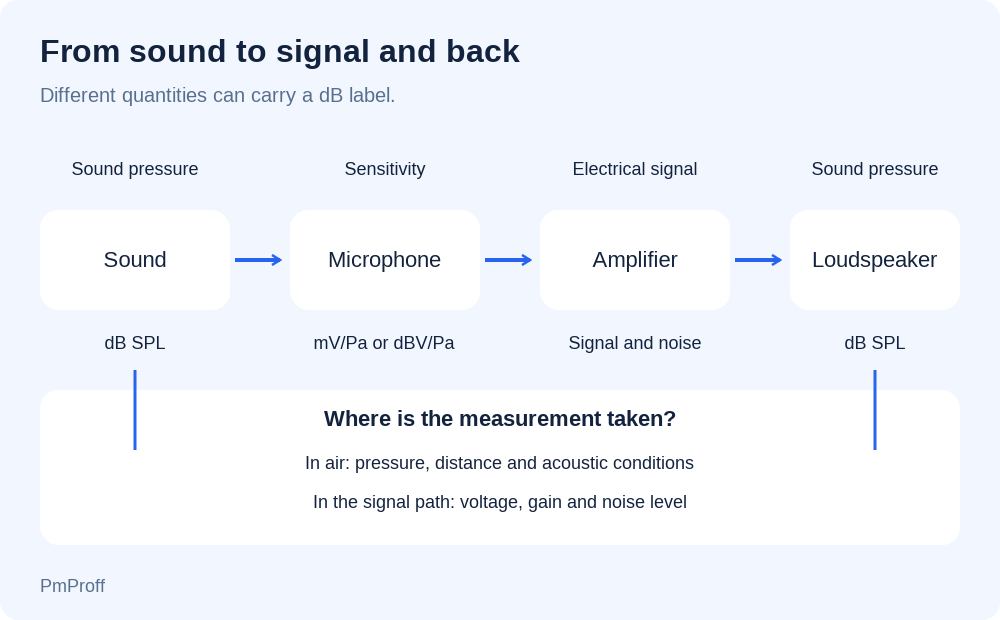
A microphone, amplifier and siren may all carry ratings in dB, but the numbers describe different quantities. To compare them, identify what is being measured, the reference level and the test conditions.
Frequency range: which sounds the device can reproduce
Sound frequency is measured in hertz. The lower limit describes bass frequencies and the upper limit describes treble. A range of “20 Hz to 20 kHz” without a tolerance gives no indication of how evenly the device reproduces those frequencies. For speech, intelligibility in the actual room matters as much as the quoted range. A microphone may deliberately emphasise particular voice frequencies, as explained in Shure’s educational guide. Audio frequencies are distinct from the radio frequency of a wireless transmitter.
Microphone sensitivity: from sound to voltage
Sensitivity describes the electrical signal a microphone produces at a specified sound pressure. It may be expressed in mV/Pa or dBV/Pa. Compare like units under the same conditions. At the same sound pressure, a 20 mV/Pa microphone delivers twice the output voltage of a 10 mV/Pa model. This does not mean it sounds twice as good. Shure’s explanation of microphone sensitivity makes this distinction: greater sensitivity alone does not make a better microphone. If a listing gives only “−52 dB”, look up the reference level in the data sheet rather than guessing.
| Parameter | What to check |
|---|---|
| Frequency range | Limits, level tolerance and intended use |
| Sensitivity | Units and reference sound pressure |
| Maximum sound level | Distance, mode and measurement conditions |
| Signal-to-noise ratio | Method, bandwidth and test level |
Maximum sound level and maximum sound pressure level
A siren or loudspeaker data sheet often expresses output level as sound pressure level in dB SPL. Always check the measurement distance. For example, the Ajax StreetSiren manual specifies siren levels at 1 m. A rating without a distance cannot be directly compared with that figure. Room acoustics, obstructions, direction and installation position affect the result. For a microphone, maximum SPL describes the input sound level at a specified distortion threshold. It does not describe output loudness. Never test a siren near your ear.
Signal-to-noise ratio: the noise behind the signal
SNR compares the wanted signal with noise. With the same test method, a higher figure generally means less noise relative to the signal. The test signal level, measurement bandwidth and frequency weighting all matter. A microphone specification does not describe the entire chain: the preamplifier, excessive gain or a power supply can introduce noise. Shure’s microphone guide covers signal levels and matching components in the audio chain. Test at the speaking distance and gain setting you intend to use.
Microphone types and intended uses
“Dynamic” and “condenser” describe how sound is converted into a signal. “Desktop”, “paging” and “conference” describe the design or use. These categories can overlap. Check power requirements, connector, pickup pattern and input compatibility. Matching audio connectors alone cannot establish that a paging microphone will work with an amplifier. For cameras, see also the difference between a microphone and two-way audio.
Checks before choosing
- Identify the task: speech, music, announcements or an alarm signal.
- Compare ratings with the same units and test conditions.
- Check power, input levels and connectors throughout the signal chain.
- Test intelligibility and noise at the actual installation site.
Frequently asked questions
Is a more sensitive microphone always better?
No. Sensitivity affects the gain required. Also consider noise, distortion and pickup pattern.
Can any two dB ratings be compared?
No. dBV, dB SPL and signal-to-noise ratio describe different quantities. Check definitions and test conditions.
Does a wider frequency range mean clearer speech?
Not necessarily. Intelligibility also depends on positioning, room acoustics, noise and settings.
In brief
Understand what the specification measures before comparing values. In audio, measurement conditions matter as much as the quoted number.