
Specifications and technology / Electrical power
An automatic transfer switch (ATS) transfers a load between sources. It generates no energy of its own and does not guarantee an uninterrupted supply. A qualified specialist must select the switching equipment using the electrical design for the site.
Two sources and one load
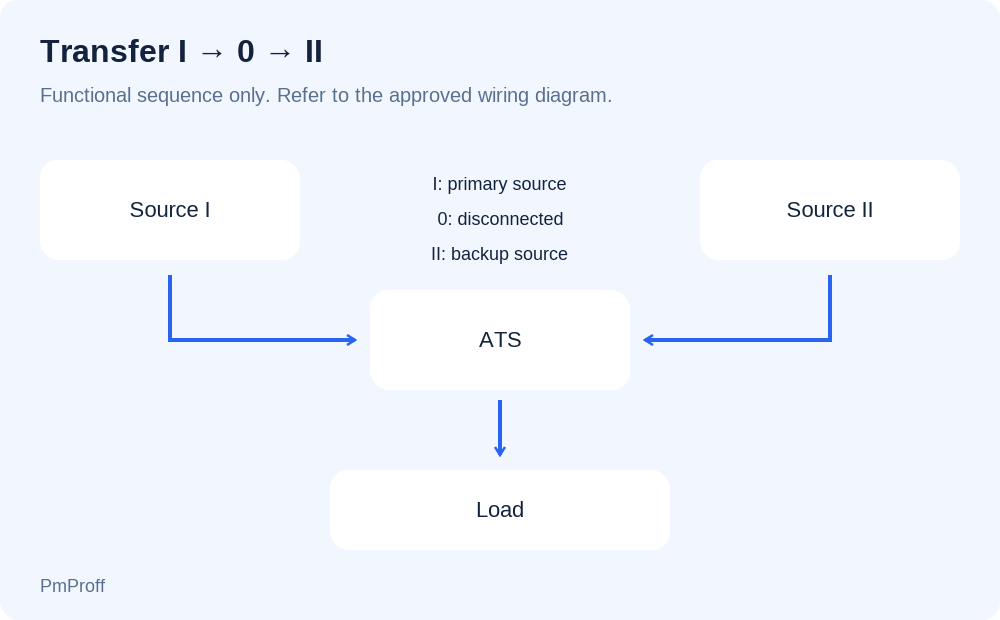
A typical ATS monitors the main source and transfers the load to a backup when specified conditions are met. Sources may include the mains, a generator or another compatible supply. The Socomec ATyS g example describes I-0-II transfer with a permitted brief interruption. An ATS cannot increase generator capacity or charge a battery on its own. To check whether an inverter output can supply an ATS, consult both devices’ documentation.
Rated current and overload protection
A rating of 100 or 125 A describes operation under specific conditions. It does not automatically imply circuit breaker functionality. Check operating voltage, load category, temperature and short-circuit ratings. The Socomec technical data list rated current, utilisation categories and short-time withstand ratings separately. The ability to carry current continuously does not determine the ability to interrupt a fault current. The design specifies protective devices and their coordination.
| Parameter | What else to check |
|---|---|
| Rated current | Voltage, utilisation category and temperature |
| Number of poles | Neutral and source arrangements |
| Transfer time | Total time to restore power |
| Automatic mode | Start, retransfer and interlocking logic |
What do 2, 3 or 4 poles mean?
Each pole is a separate switched electrical path. The number required depends on the system and neutral arrangement. Knowing only the number of phases is insufficient. ASCO’s bulletin on transfer switch neutrals explains how source and earthing arrangements determine the choice between a solid and a switched neutral. Choosing 3P or 4P on the basis of generic advice can impair protection and create hazardous conditions.
Transfer time and supply interruption
Contact travel time is only part of the interval between mains failure and a stable backup supply. The sequence may also include failure confirmation, generator startup and stabilisation, and eventual retransfer to the main source. ASCO distinguishes neutral switching arrangements and contact operating sequences. An ordinary ATS must not be assumed to support the overlapping transfer available on special designs. If the load cannot tolerate an interruption, assess the need for a UPS and verify compatibility throughout the system.
What to specify when selecting a switch
Provide both source ratings, load types, starting currents, earthing arrangement, maximum permissible interruption and generator control method. Check manual operation, position indication, interlocking against simultaneous source connection and service access. Use an agreed commissioning procedure to test failure, recovery and loss of the backup source. The functional diagram here is not a guide to wiring power conductors.
Checks before choosing
- List the sources and loads.
- Agree on the neutral arrangement and protective devices with the designer.
- Define the maximum acceptable supply interruption.
- Test failure scenarios during professional commissioning.
Frequently asked questions
Can an ATS replace a UPS?
No. A transfer switch has no stored energy of its own and may interrupt the supply.
Does a 125 A switch increase the capacity of the backup source?
No. This is a rating of the switch under specified conditions. The source has its own rating.
Can I choose pole count from phase count alone?
No. The neutral arrangement, earthing and professional equipment selection are also required.
In brief
Choose the ATS as part of the electrical system. Assess current, pole count and transfer time together with the protection scheme and backup source.