
Specifications and technology / Backup power
Maximum charging current is a battery limit. The charger need not operate at that current. First check the chemistry, number of cells in series and voltage profile, then consider how quickly the charge must be restored.
Check voltage and charging profile before current
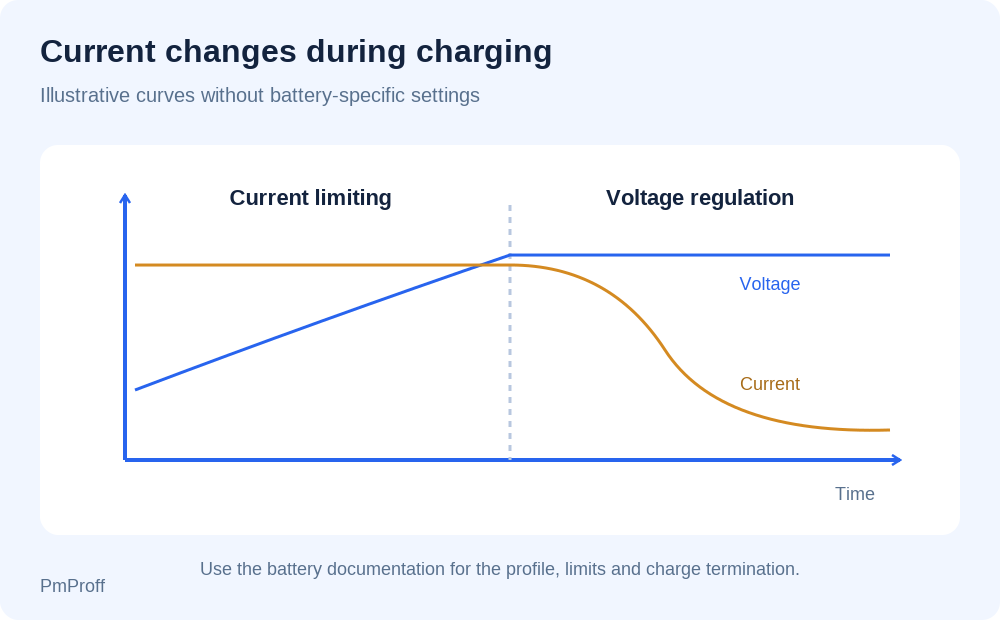
In multistage charging, current does not remain at its maximum until the end. Once the target voltage is reached, the current usually falls. Victron describes absorption as holding the voltage while the current varies. Check the battery data sheet for specific voltages, durations and whether a maintenance stage is permitted.
How to reconcile the limits
Compare the battery’s recommended and maximum currents with the capabilities of the charger, BMS and wiring. The lowest applicable limit governs the system. Two batteries marked 12 V may require different settings. Do not transfer settings from an old lead-acid battery to LiFePO4 on the basis of voltage alone. Check temperature limits for charging as well.
| Specification | Purpose |
|---|---|
| Chemistry and profile | Correct charging algorithm |
| Final charging voltage | Battery compatibility |
| Current | Charging rate within permitted limits |
| Temperature | Permitted charging conditions |
Why charging time is an estimate
Suppose you need to replace 40 Ah and the battery receives a constant 10 A. Division gives 4 hours, but real charging includes losses and a final stage in which current falls. If the load uses part of the charger’s output, less is available to the battery. Four hours is an initial estimate, not a guaranteed completion time.
When the charger also powers equipment
The charger’s output current can be shared between the battery and connected loads. The Blue Smart IP22 manual discusses how a load affects the assessment of charge completion. When testing charging time, record the battery’s starting condition, actual current and which devices are operating.
Choosing a charger for repeated outages
If the interval between outages is short, estimate the energy used during the last outage rather than a full charge from empty. Check whether the system can restore that energy within the available time while respecting the rated limits. Increasing current cannot correct an unsuitable profile or ensure the battery will accept that current throughout the charge.
Checks before choosing
- Take the limits from the battery data sheet.
- Allow for loads operating during charging.
- Check the actual cycle, battery temperature and whether the BMS trips.
Battery current and solar input current
“120 A for the battery / 160 A for solar panels” refers to different sides of the system. These are not interchangeable battery charging currents. Check the definitions in the data sheet. Battery charging current, MPPT input current and array limits may apply at different voltages and under different conditions. Size the wiring and protection for the relevant circuit. For the battery, check its own permitted limit and the inverter settings.
Frequently asked questions
Is a higher-capacity charger dangerous?
Compatibility depends on the charging profile and configured current limit as well as the charger’s maximum capability.
Can I calculate the exact time by dividing Ah by A?
That calculation assumes constant current. Charge termination and simultaneous loads change the actual time.
Will the BMS configure any charger automatically?
No. Battery protection cannot replace a compatible charging algorithm.
In brief
Check the charging profile and permitted limits first, then estimate the time and verify it over an actual cycle.