
Specifications and technology / Access control
A closer should shut the door reliably without excessive opening force or slamming. Selection by door weight alone can give poor results. Leaf width, mounting arrangement, seals, lock and entrance conditions all matter.
Check both door weight and width
A wider leaf loads the mechanism differently. Check both width and weight limits, the closing force class and the mounting method. The GEZE Boxer data sheet lists these parameters separately. “Up to 180 kg” does not make a closer suitable for every door of that weight. Wind, pressure differences, seals and hinge condition also affect performance. Correct misalignment or rubbing before adjusting the closer. Excess closing force is a poor way to compensate for a binding door.
Articulated arm and slide track
An articulated arm has jointed sections. In a slide-track system, a slider moves along a guide. This changes the mounting geometry, appearance and space required. Opening effort depends on the whole mechanism and its adjustment as well as the arm type. GEZE’s technical brochure gives mounting dimensions for different versions. Check the door handing and mounting side, frame depth, available space and obstructions. Use the dimensions for the actual model.
| Parameter | Distinct from |
|---|---|
| Door weight | The full set of selection criteria |
| Closing speed | Mechanism force |
| Latching action | Slamming |
| Hold-open | Backcheck |
Closing speed and latching action
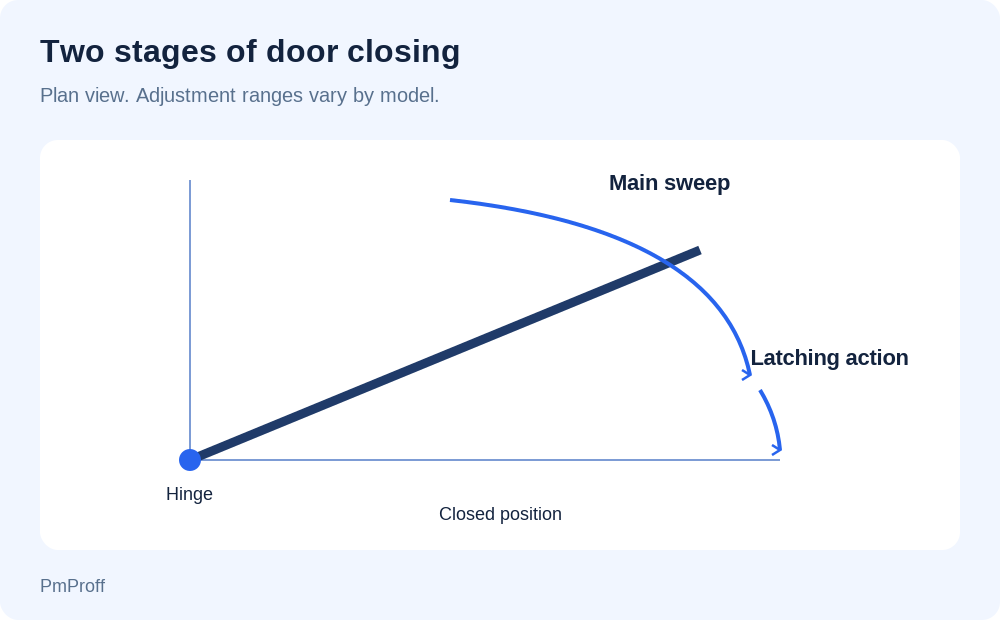
Sweep speed governs most of the door’s travel. Latching action governs the final section, where the door must overcome resistance from the seals and latch. GEZE’s guide to adjustment distinguishes closing force, sweep speed, latching action, backcheck and delayed action. Increasing speed cannot compensate for the wrong force class. Excessive latching action makes the door slam. Insufficient action can leave it unlatched. Follow the model’s adjustment instructions. Unscrewing valves too far can damage the mechanism.
Holding the door open
A hold-open device retains the door in an open position. Backcheck slows a door that is being opened sharply. Never wedge a fire or smoke-control door open or fit an arbitrary mechanical hold-open device. Use a system approved for that door assembly and verify its alarm response. “Suitable for fire doors” on a closer does not establish compatibility with every hardware combination. In its Boxer data sheet, the manufacturer explicitly requires proof of suitability for the particular door.
Cycle life and checks after installation
Cycle life is a rating under specified test conditions. It does not guarantee a number of calendar years. Use the manufacturer’s definition of one cycle. For example, 1,000 cycles per day and 100 cycles per day represent different usage intensities even on identical doors. Test closing from several angles, reliable latching and freedom from dangerous slamming. Have a qualified specialist install and check closers on escape routes and fire-rated assemblies.
Checks before choosing
- Measure the leaf and check its weight.
- Check the mounting geometry and arm type.
- Check that the door latches without impact or binding.
- For special-purpose doors, confirm suitability of the complete assembly.
Frequently asked questions
Should I choose the closer with the highest closing force?
Excess force can make the door hard to open. Choose the appropriate force range and setting.
Should the door slam during latching?
No. Latching action should close the door securely without slamming.
Does a million cycles equal a particular number of years?
Only as an estimate based on assumed usage. It is not a calendar-life guarantee.
In brief
Select the closer for the complete door assembly. Closing speed, force, latching action and hold-open are separate functions.