
Specifications and technology / Fire alarms
Choosing a fire detector involves more than sensor type or wire count. It must be compatible with the particular fire alarm control panel, communication circuit and system design. This guide explains data sheet specifications. Installation requires the approved design and procedures.
Smoke, heat, manual and multisensor devices
A smoke detector responds to signs of smoke. A heat detector responds to temperature or its rate of change according to its class. A manual call point is activated by a person. A multisensor detector combines sensing channels. For example, the TIRAS DETECTO 10 series includes smoke, heat and combined models. “Point-type” describes detection at the installation point. “Addressable” describes how the device communicates with the system. Both terms may appear in the same catalogue field. When choosing between smoke and heat detectors, let room conditions and design requirements determine the choice. Price alone cannot establish suitability.
Device address, circuit and zone
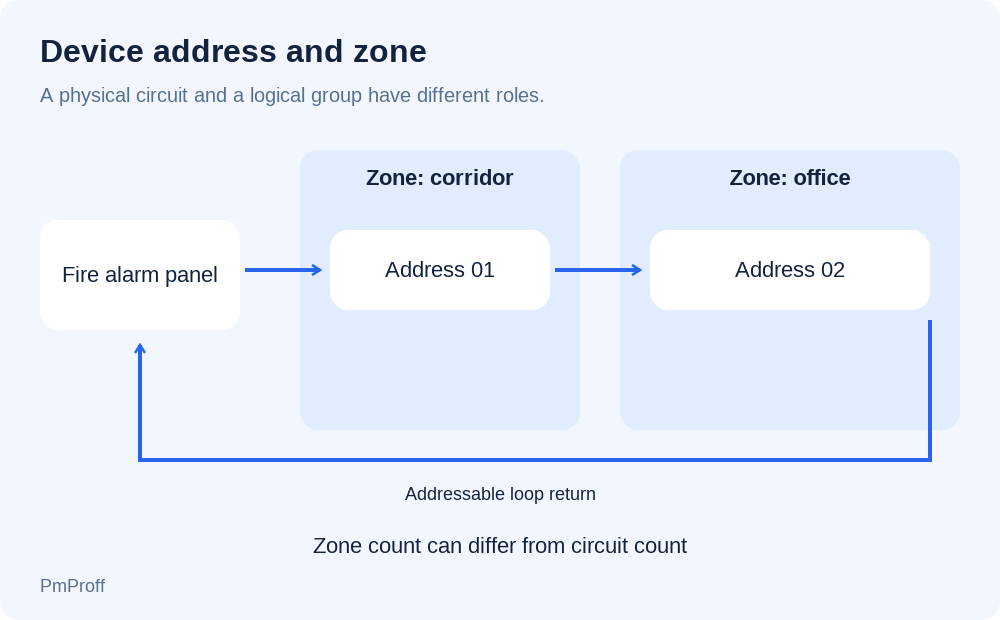
An addressable device has an identifier that allows the panel to distinguish it from other devices. A conventional circuit generally reports the circuit state, with specific capabilities depending on the equipment. A zone is a logical area of the premises. A circuit or addressable loop is a physical connection. Multiple devices can belong to one zone. The Tiras PRIME A manual describes addressable interfaces and zones separately. Use the limits of the particular panel rather than multiplying the circuit count by an assumed detector count.
| Symbol | What it describes |
|---|---|
| Addressable | Device identification within a compatible system |
| Circuit / loop | Physical connection |
| Zone | Logical monitored area |
| Standby / alarm | Different current consumption modes |
Device capacity and expansion
A data sheet may give capacities for the base panel, one loop and the system with expansion modules. Each figure applies to its own configuration. The TIRAS addressable system description lists base loops and expansion separately. The design must also account for current consumption, line length and characteristics, isolators and permitted configurations. Two wires do not imply a universal protocol. Use the manufacturer’s compatibility documentation for the exact models and versions. Matching voltage alone is insufficient.
Operating temperature threshold and current in two modes
Read a response interval such as 54–70 °C alongside the heat detector class and test method. It is neither a recommended room temperature nor a guarantee of activation at one precise temperature under all conditions. Standby and alarm current may differ considerably. A slash between the values denotes two modes, not a range of arbitrary consumption. Power supply and backup calculations must cover the system’s operating scenarios. Address count alone cannot establish maximum capacity without checking electrical limits.
Checks before purchase
Give the designer the exact part numbers for the panel, detectors, bases and modules. Ask for confirmation of compatibility, a zoning plan, backup calculations and a test schedule. For example, the SPR Tiras Ex manual call point description names compatible panel families and the intended application of that version. Ordinary security accessories cannot substitute for explosion-protected components, fire warning equipment or automation control devices. A marking on one device alone cannot demonstrate that the complete system meets site requirements.
Checks before choosing
- Check the exact models against the compatibility list.
- Distinguish base capacity from expanded capacity.
- Include both current consumption modes.
- Arrange qualified design review and commissioning checks.
Modules, inputs, outputs and event logs
An input receives a state or signal, an output provides control, and a logical output may exist in software with no separate terminal. A high output count need not equal the number of physical relays. Check the data sheet and system configuration. An expansion module and an intrinsic safety barrier serve different purposes. The word “module” alone does not make them interchangeable.
Event log capacity counts stored records. Users and detectors have separate limits. Check overwrite behaviour, export, timestamps and retention after failure. Push notifications, SMS and calls have different delivery dependencies. Panel screen size and resolution describe its interface. Manufacturer documentation and the system design establish fire alarm compatibility and permitted configurations.
Frequently asked questions
Will any two-wire detector work?
No. Conductor count does not determine the protocol, electrical compatibility or approved equipment combination.
Does each address represent a separate zone?
Not necessarily. A device address and a logical zone are separate concepts.
Can a heat detector be replaced with a smoke detector?
Only after a qualified specialist has checked the design, room use and system compatibility.
In brief
First confirm purpose and compatibility, then check circuit limits, power supply and backup. Detector count is only one of these considerations.