
Specifications and technology / Inverters
Peak power is a short-duration rating. An inverter may briefly support a load above its continuous rating. Check both the surge power and how long the overload is permitted.
Check running consumption, startup demand and battery capability. An inverter with a large rating can still shut down if any part of the system falls short.
Nominal, continuous and peak power
| Parameter | Purpose | What to check |
|---|---|---|
| Continuous power | Operation after startup | Temperature and cooling conditions |
| Peak power | Short transient load | Permitted duration |
| Overload curve | Checking a particular startup load | Power versus time |
Read the specification table as well as the model name. For example, Victron’s SUN Inverter lists VA, continuous watts at different temperatures and peak watts separately. One figure cannot describe every mode. Example Victron specification.
What happens at startup?
A motor, compressor or electronic supply may briefly draw more current than it does in steady operation. No single startup multiplier applies to every appliance. The surge depends on design, load and control method.
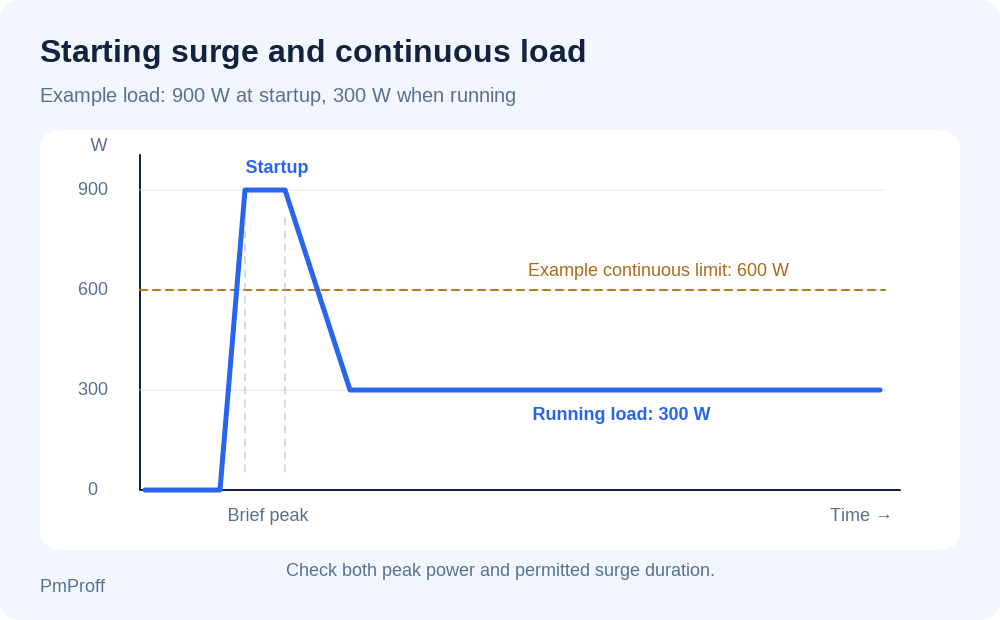
Suppose an appliance needs 300 W in operation and briefly draws 900 W at startup. An inverter rated at 600 W continuously may carry the running load, but startup needs a separate check. “1000 W peak” without duration or conditions does not establish compatibility.
Other appliances continue drawing power while one starts. Add their running consumption and consider whether several could start together.
VA and watts describe different limits
VA measures apparent power and W measures real power. The values differ when the load’s power factor is not one. A fixed “multiply by 0.8” rule will not work for every device.
Stay within both manufacturer limits where both are stated. The load and its transients determine how much headroom is needed. For the relationship between VA, watts and power factor, see the Eaton technical guide.
Can the battery supply the current?
The inverter draws its energy from the DC side. Approximate input current is I ≈ P ÷ (U × η). With 1000 W, 12 V and efficiency of 0.9, this gives about 92.6 A. At 24 V with the same assumptions, it gives about 46.3 A.
This example estimates current only. In use, battery voltage sags, efficiency varies and startup current can be higher. Check the battery, BMS, fuses, terminals and recommended cable cross-section against the documentation. Victron inverter installation requirements.
Temperature and ventilation
Continuous power may fall as temperature rises. The SUN Inverter example gives separate power ratings at 25 °C and 40 °C. Use the temperature conditions specified for the inverter you are choosing.
An enclosed cabinet with inadequate ventilation changes operating conditions. Check clearances, orientation, permissible temperature and service access before installation. For responses to overheating and overload, see the operating manual.
A fixed backup system requires the correct transfer arrangement, protection and earthing. Have a qualified specialist carry out the work.
Information needed to choose an inverter
- A list of appliances with running watts and VA where specified.
- Startup data or measurements from a suitable instrument.
- Expected simultaneous load.
- Battery voltage and permitted BMS currents.
- Required output waveform.
- Ambient temperature and installation conditions.
- Required runtime, calculated separately from available energy.
Off-grid, hybrid and power assist modes
“Off-grid” describes a stand-alone output, but a particular inverter may also have a mains input for charging or bypass. A hybrid system can combine battery, solar and mains. Check which modes it supports. For a power assist or blending mode, establish whether the battery supports local loads, how consumption is measured and whether grid export is permitted.
Victron describes a controlled ESS installationin which available modes depend on equipment and settings. An on-grid/off-grid label is never permission to connect the output to a household socket. A specialist must check grid operation, anti-islanding protection and connection requirements.
Maximum solar array power and rated AC output power are separate limits. A higher array nameplate rating cannot increase inverter output capacity. Check voltage, current and MPPT count as described in the solar panel compatibility guide. Compare the peak AC rating with the duration of the load, independently of PV power.
AC outlets and grid-tie/off-grid modes
Several AC outlets may share the unit’s rated power. Check both the total limit and the limit for each outlet. Grid-tie and off-grid modes interact differently with the grid and load. Grid operation alone does not guarantee backup during an outage.
If one specification lists ports and power ratings for several modes, read each against the exact model’s data sheet. Connecting to building wiring requires a design approved by a qualified specialist. Never feed power into a household outlet to test a mode.
Frequently asked questions
Will a 2000 W inverter run for two hours?
Watts describe power. Runtime depends on the battery, load, usable discharge and losses.
Why does the inverter shut down only during startup?
Possible causes include a startup overload, battery voltage sag, a BMS trip or poor DC connections. Check the system as a whole.
Is 20% headroom enough for every appliance?
No. Determine headroom from the load type, startup behaviour and manufacturer requirements. No single percentage covers every situation.
Compare continuous power, brief startup demand and DC-side capability. Check battery runtime and installation safety separately.