
Specifications and technology / Control and access
A dry contact acts as a controlled switch: it opens or closes an external circuit without supplying power to it. NO, NC and COM describe the contacts. Check the voltage rating separately to determine what they can safely switch.
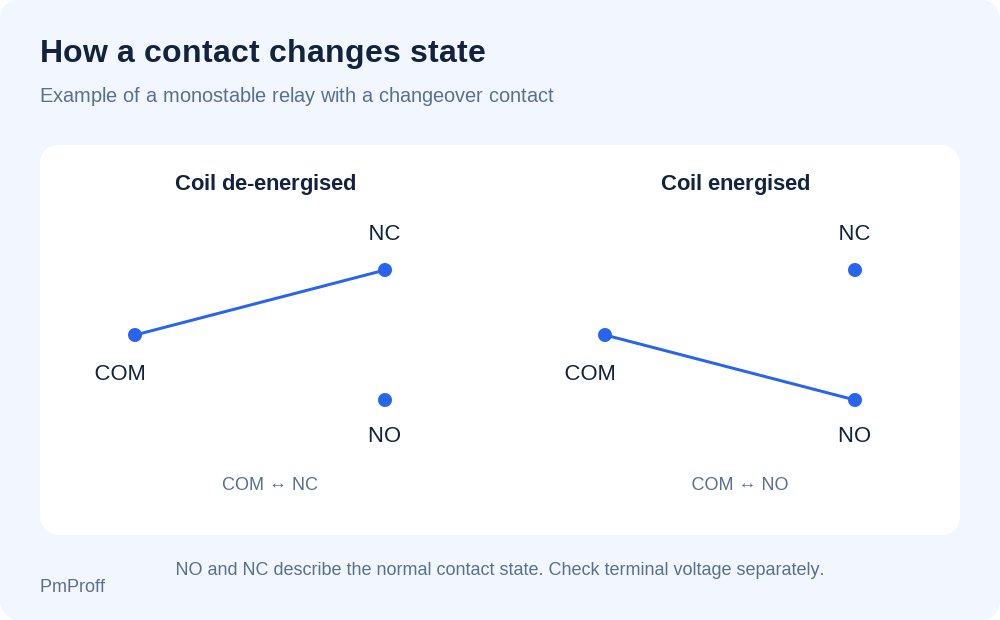
Three labels on one relay
COM is the common contact. In the normal state, NO is open and NC is closed. For a conventional monostable relay, normal means the coil is de-energised. Energising the coil switches the common contact. See the Omron technical guide. For a latching or programmable device, check its initial state separately.
A dry contact still has a voltage limit
Check the permitted voltage, current and load type. A relay may have different AC and DC ratings. An inductive load, such as a lock coil, behaves differently from a resistive load. Omron’s relay application guidance explains why a contact rating for one load cannot be assumed to apply to another.
| Symbol | Quantity |
|---|---|
| COM | Common contact |
| NO | Normally open |
| NC | Normally closed |
| Dry contact | Supplies no voltage of its own to the controlled circuit |
Contact, voltage output and open collector
“Output” can refer to several circuit types. A dry contact, a 12 V output and a transistor output are electrically different. For example, a controller’s push-button input may require only contact closure. Applying voltage to it can damage the equipment unless the manual permits it. Terminal count and wire colours do not establish the output type.
Example: choosing a relay for a gate controller
Find the external push-button input in the gate controller manual. If it requires a brief dry-contact closure, choose a relay that supports pulse operation. Do not apply continuous power. Then check the pulse duration and the state after a restart. This example explains selection. Use the specific gate controller’s diagram for wiring.
What to test after configuration
Test the response to a command, power restoration, loss of communication and a repeated command. Record the expected states so that the installer and owner agree on what “on” means in the app. Have a qualified professional install mains wiring and power circuits.
Checks before choosing
- Identify the input type of the controlled device.
- Check the contact ratings and load type.
- Check pulse mode and the state after a restart.
Buttons and relay count
A contact-operated button requires a physical press. A touchless button may use a sensor. Check the model’s sensing technology and power requirements. An exit button and a panic button serve different purposes even when both use NO/NC contacts. Relay count indicates the number of independent relay units. It does not specify their load current ratings.
“Normally closed” in an electric strike listing may refer to the mechanism’s state under a specified power condition rather than a contact configuration. Check the data sheet and the state on power failure rather than relying on a single translated term. For locks, also check fail-safe and fail-secure operation.
Frequently asked questions
Is COM the negative supply terminal?
No. On a changeover relay it is the common contact. Check other terminal labels against the manufacturer’s diagram.
Does NO mean the device is currently off?
Not necessarily. NO describes the contact in its defined normal state. The app may report a different operating state.
Can I connect a lock directly to any relay?
No. The ratings and power supply must be compatible, and the circuit needs the protection specified by the manufacturer.
In brief
Contact labels explain switching logic. Check electrical compatibility separately.