
Specifications and technology / Power
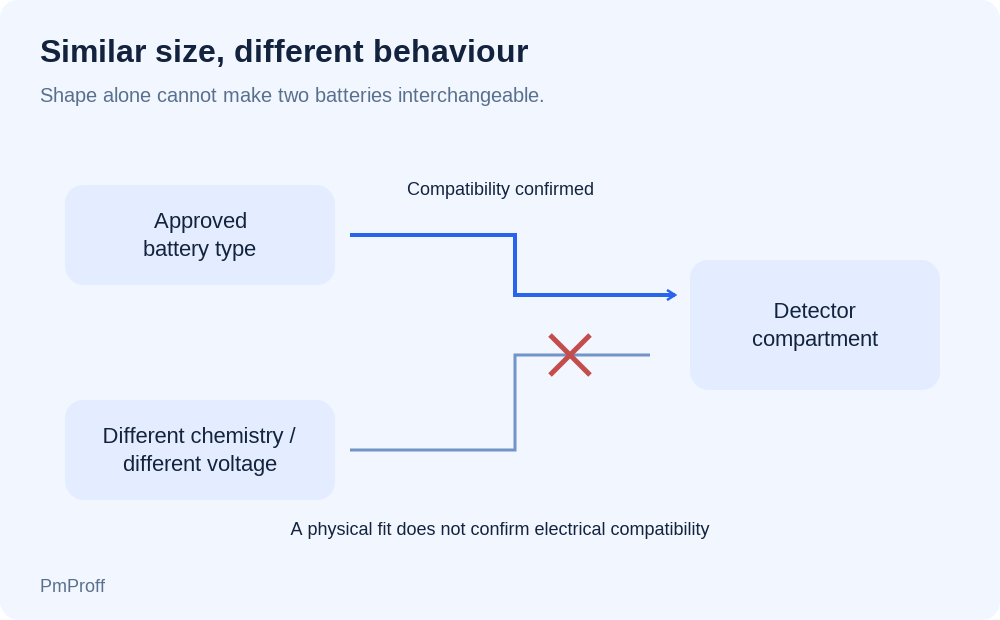
A sensor needs more than a battery that fits the compartment. Check the exact designation, voltage, chemistry, quantity and manufacturer’s requirements. A rechargeable cell of similar size may be unsuitable.
Size is only one battery specification
AA and AAA describe common sizes. Cells of the same size can have different chemistry and electrical behaviour. CR123A, CR2, CR2032 and CR2450 are also different types and cannot be freely interchanged. Energizer’s battery comparison distinguishes primary and rechargeable ranges. Start with the exact types approved for your sensor. A general “lithium” label is insufficient.
Primary and rechargeable cells
Primary cells are designed for single use and must not be recharged. Energizer’s battery care guidance warns against recharging primary cells, mixing old and new batteries or combining different types. A rechargeable lookalike must meet the device’s voltage and load requirements as well as its dimensions. Do not use damaged, leaking or deformed cells.
| The label | What to check |
|---|---|
| AA / AAA | Approved chemistry and voltage |
| CR123A / CR2 | Exact designation and quantity |
| CR2032 / CR2450 | Size and fit |
| Rechargeable | Whether rechargeable cells are permitted |
Check quantity and polarity
CR123A × 2 specifies two cells of that type. Do not substitute an arbitrary source with a similar combined voltage. Observe polarity and follow the replacement sequence in the manual. The Transmitter battery replacement instructions list specific recommended models and a status check after power-up. Do not assume that another device with a similar name uses the same number of cells.
Why battery life varies
Rated service life in years assumes specific conditions. Event frequency, photo transmission, radio link quality, temperature and settings can all affect consumption. Check the cell’s intended application and the device requirements as well as the capacity on the packaging. The charge indicator may take time to update after replacement. Wait for the specified update cycle and test actual operation.
Checks after maintenance
At a monitored site, arrange maintenance in advance so opening the enclosure does not trigger an unnecessary response. After replacement, check the enclosure is closed, communication works and a test event arrives. Keep batteries away from children, particularly small coin cells. Store used cells separately from new ones and take them to a designated collection point.
Checks before choosing
- Find the approved battery in the model’s manual.
- Replace the set according to the manufacturer’s instructions.
- Check polarity and enclosure closure.
- Test communication and a sample event.
Frequently asked questions
Can I recharge an ordinary CR battery?
Never recharge a primary cell. Use only batteries intended for recharging and a compatible charger.
Is the same size enough?
No. Voltage, chemistry and electrical characteristics must also match.
Will new batteries last the number of years on the data sheet?
Not necessarily. Life depends on operating conditions and settings.
In brief
Choose the battery specified for the sensor. After replacement, check actual operation as well as the indicator.