
Specifications and technology / Video surveillance
A thermal imager forms its image from infrared radiation rather than visible light. Evaluate thermal sensitivity, spatial detail and temperature measurement accuracy separately.
NETD: resolving small temperature differences
NETD is expressed in millikelvins. Under comparable conditions, a lower value indicates a better ability to distinguish low thermal contrast. FLIR explains thermal sensitivity as one aspect of thermal image quality. “Less than 35 mK” does not mean temperature accuracy of ±0.035 °C. NETD describes noise and contrast. Absolute measurement error is a separate specification. A thermal security camera may not provide calibrated temperature measurements.
Test temperature and lens
The NETD rating may include a scene temperature and lens f-number. Both affect the result. FLIR discusses how lens aperture affects NETD. Make allowance for different optics and test conditions when comparing figures. A qualifier such as “@25 °C, F/1.0” is part of the specification.
| Parameter | What it describes |
|---|---|
| NETD, mK | Ability to resolve low thermal contrast |
| Pixels | Spatial sampling |
| Field of view | Scene coverage |
| Palette | How measured values are displayed |
Resolution and pixel pitch
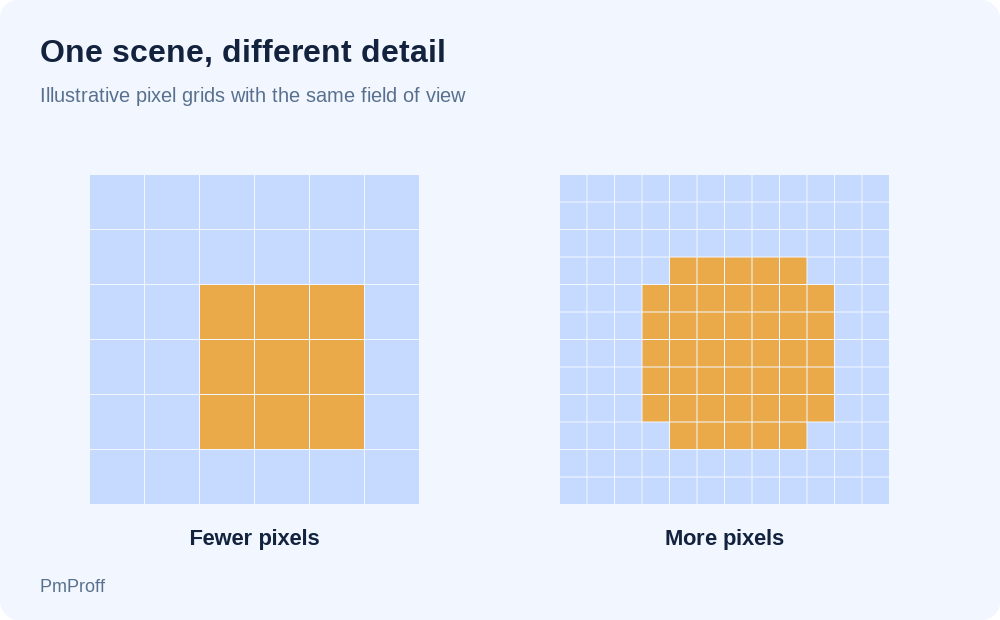
640 × 512 gives the number of image elements. A figure of 12 µm describes the sensor’s physical pixel pitch. More pixels at the same field of view can resolve finer spatial detail, but pixel count alone does not determine recognition range. The physical sensor dimensions depend on pixel count and pitch. The FLIR T540 specifications list pitch, optics and field of view separately. Check native resolution rather than interpolated or digitally enlarged image size.
Focal length, spectrum and field of view
On the same sensor, a longer focal length generally narrows the field of view. Lenses with the same focal length on different sensors can cover different areas. Use the actual horizontal and vertical angles for the specific thermal camera. A spectral range such as 8–14 µm describes the wavelengths the system detects. Temperature and distance are different quantities. A thermal channel works differently from a conventional camera with infrared illumination. On a dual-channel camera, check each channel’s specifications.
Palette and temperature measurement
White Hot and Black Hot change how warm and cool areas appear. A palette can make a scene easier to interpret, but cannot add pixels or improve the sensor’s physical sensitivity. Temperature measurement requires a camera with that function and appropriate scene settings. FLIR’s measurement documentation emphasises surface emissivity, distance and environmental conditions. A bright area on the display alone cannot establish its exact temperature.
Checks before choosing
- Compare NETD under the same conditions.
- Check native resolution and field of view.
- Distinguish the thermal and visible channels.
- For temperature measurements, check the accuracy specification and calibration conditions.
Frequently asked questions
Does 35 mK mean a measurement error of 0.035 °C?
No. NETD and absolute temperature accuracy are different specifications.
Does the Rainbow palette add information?
It assigns different colours to existing data without increasing resolution.
Is a longer focal length always better?
No. It changes coverage. Balance the required scene width against the detail needed on the subject.
In brief
Compare thermal contrast, spatial detail and temperature accuracy separately. A leading figure in one field cannot determine overall performance.