
Specifications and technology / Access control
A turnstile must fit both the opening and the route people use every day. Cabinet width, clear passage and processing time describe different constraints. Start with how people will enter rather than the highest listed passages per minute.
Passage width and room for the cabinet
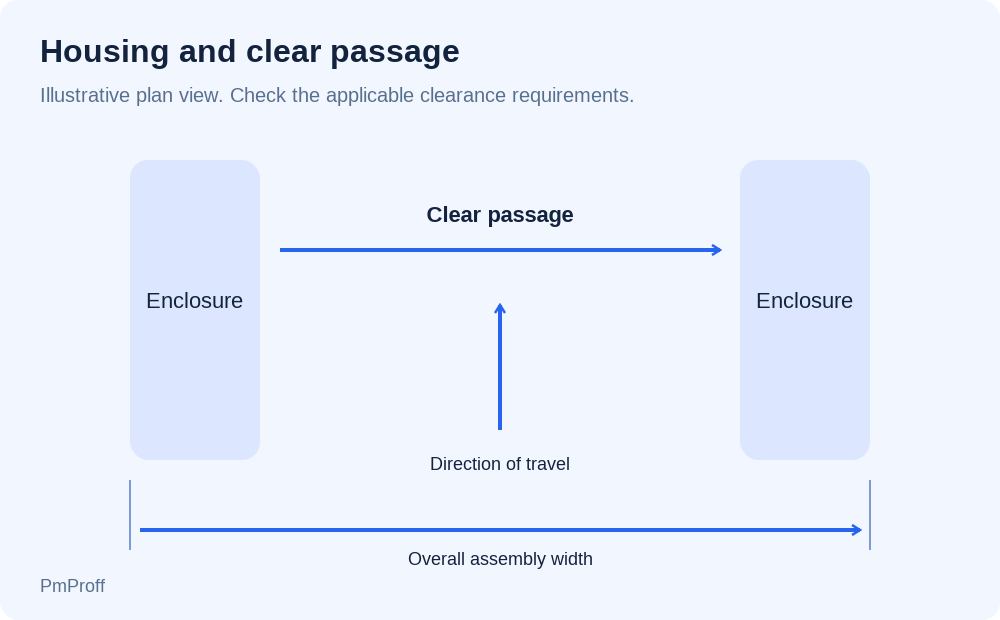
Passage width is the space available to a person between obstructions. The layout must also accommodate cabinets, barriers, gates and the approach. The TiSO Sweeper-SH specifications list cabinet dimensions and passage width separately. A slim cabinet does not necessarily give a wide passage. Check the actual clearance with the gate fully open, including any handrails or adjacent fittings.
Throughput: rated figures and actual queues
Rated throughput depends on test conditions. At a real entrance, people need time to find a card, have permissions checked, wait for opening, walk through and let the mechanism reset. If the entire cycle takes 3 seconds, the theoretical limit for one lane is 20 passages per minute. This is an arithmetic example. Pauses, luggage and retries reduce actual throughput. Size the entrance for peak periods as well as total staff numbers. For opposing flows, check how the lane switches direction.
| Parameter | Design question |
|---|---|
| Passage width | Who will use the lane and what will they carry? |
| Throughput | What are the peak flow and identification method? |
| Emergency release | What happens during an alarm or power failure? |
| Service life | Cycles or hours, and under what conditions? |
Tripods, rotors and gates
A tripod uses arms to restrict passage, a rotor uses a rotating barrier, and a gate opens or retracts its leaves. Half-height and full-height refer to barrier height. The design name alone cannot tell you what happens when power fails. An electromechanical mechanism may simply unlock to allow movement, while a motorised unit moves the barrier itself. Check the exact behaviour in the data sheet. TiSO’s tripod overview shows different designs and emergency mechanisms. Match entry, exit and locked modes to the access controller.
Emergency release and accessible passage
Emergency release can drop an arm or open gates. Check how it is triggered, what happens on power failure and how normal operation is restored. Dropping an arm does not increase the distance between cabinets. TiSO explains the difference between wide passage and emergency release. Provide a suitable route for wheelchairs, pushchairs and luggage. The design and applicable site requirements determine suitability for evacuation. A “Yes” entry in a catalogue is insufficient. A qualified specialist must verify integration with the fire alarm.
Cycle ratings and servicing
A rating in millions of passages does not guarantee failure-free operation for a set number of years. MTBF is measured in time and MCBF in cycles. If a listing mixes the name and units, ask the manufacturer to clarify. Usage, environment and maintenance affect service life. Converting cycles to years requires an assumed traffic load. When purchasing, also consider service availability, inspection intervals and safe passage during repairs.
Checks before choosing
- Draw the cabinets and clear passage to scale.
- Allow for an accessible route and peak traffic.
- Check controller modes and the emergency operating sequence.
- Agree on evacuation arrangements with a qualified specialist.
Frequently asked questions
Is passage width the same as the turnstile’s overall width?
No. The cabinet and barriers take up additional space.
Does emergency release always operate without electricity?
This depends on the model’s design, backup power and configuration.
Will higher rated throughput eliminate queues?
Not always. Identification time or the arrangement of pedestrian flows may be the bottleneck.
In brief
Compare clear passage, the complete processing cycle and emergency operation. Each describes a different requirement.