
Specifications and technology / Access control
Fail-safe and fail-secure describe electrically controlled locking after power loss. The terms do not rate the overall safety of a door or establish its suitability for evacuation. Check egress from inside, the operation of the door and the site’s requirements separately.
Two responses to power loss
A fail-safe lock unlocks the electrically controlled side when power is lost. A fail-secure lock keeps that side locked. Allegion explains the distinction in terms of access behaviour. A particular mechanism may also have an independently operated handle or key.
Entry and exit need separate checks
A locked entrance from outside does not necessarily block exit from inside. In some mechanical arrangements, the inside handle operates independently. Other systems require dedicated devices and coordinated controls. Allegion’s overview of lock functions illustrates different handle and locking arrangements. Use the requirements applicable to your site rather than assuming another country’s rules apply.
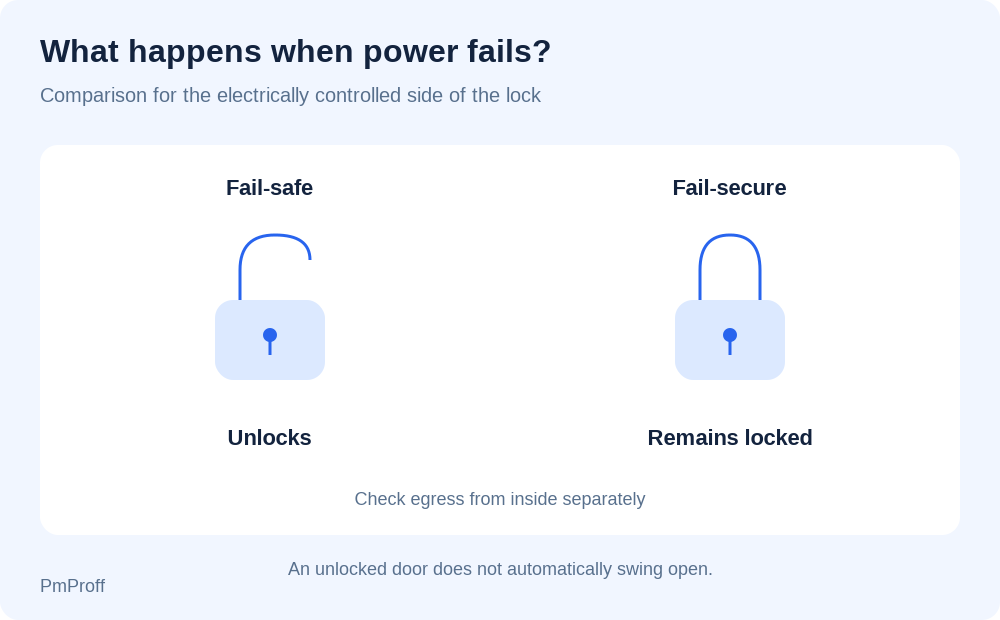
| State without power | Electrically controlled side |
|---|---|
| Fail-safe | Unlocks |
| Fail-secure | Remains locked |
| Egress from inside | Check separately for the door assembly |
What backup power changes
Backup power can maintain normal operation during a mains outage. It does not change the lock’s inherent power-loss behaviour. Determine what happens when the backup is exhausted, control is lost or an emergency command arrives. Battery runtime and maintenance matter as well as the presence of a battery.
Holding force is one part of the selection
A rated holding force says little about door quality, mounting, alignment or ease of passage. Check the door leaf’s weight and construction, opening direction, door closer and required manual access method. A lock that works on a test bench may fail to engage on a misaligned door.
What to specify for the installer
Describe four conditions: normal operation, mains loss, controller failure and emergency egress. Specify how each side of the door should behave in each condition. A qualified specialist must verify escape-route arrangements and fire alarm integration against the site’s current requirements. These definitions do not replace an installation design.
Checks before choosing
- Confirm the behaviour on both sides.
- Check what happens after backup power runs out.
- Agree egress and emergency modes with a specialist.
Door compatibility, exit buttons and status monitoring
Door type, leaf thickness, opening direction and frame geometry determine mechanical compatibility of the lock and fixings. Holding force describes the lock’s tested load, not a burglary resistance rating for the whole door. Check the exact limits and mounting kit in the data sheet.
An exit button may use mechanical, touch-sensitive or touchless activation. The NO/NC contact designation describes its electrical state, separately from the activation method. The guide to NO, NC and COM helps distinguish a control signal from lock power. A gate-open command typically goes to a compatible controller input. It does not directly power the motor.
A door position sensor reports the position of the leaf. A lock monitor may report a different condition, such as whether the lock has engaged. One reading does not guarantee the other. Depending on the device, a timer can set command duration or delay an action. Do not set an emergency exit delay from a generic figure. A specialist must check the arrangement against the door design and site requirements.
Frequently asked questions
Does a fail-secure lock always trap a person inside?
No. Egress may be mechanically independent. Confirm this for the particular assembly.
Does a battery turn a fail-safe lock into a fail-secure lock?
No. It temporarily maintains power.
Is holding force enough to choose a lock?
It is only one specification. Check door compatibility, mounting and the required access scenarios.
In brief
Select the required power-loss behaviour and verify both sides of the door. The mode name alone cannot establish safe evacuation.