
Specifications and technology / Access control
The card, reader, controller and lock form a chain. Card-to-reader compatibility alone cannot guarantee that the controller will receive the correct number and grant access. Check every link.
The reader sends data and the controller decides
The reader obtains the identifier. The controller checks it against access rights and operates the output. A standalone device can combine both functions in one enclosure. HID provides separate support for controllers and door readers. “Built-in controller with reader” describes combined roles. It does not specify capacity, logging or networking features. A standalone device may still use a network. Check where permissions are stored and which functions survive a server outage.
Wiegand interface and message format
Wiegand describes a reader-to-controller data interface. The message format separately defines the bit count, field positions and check bits. Two devices with a Wiegand interface may interpret the same number differently. For example, XPR’s Wiegand format documentation describes how the data structure is configured. A reader beep alone does not verify the result. Check the number reported by the controller and test with both an authorised and an unauthorised card.
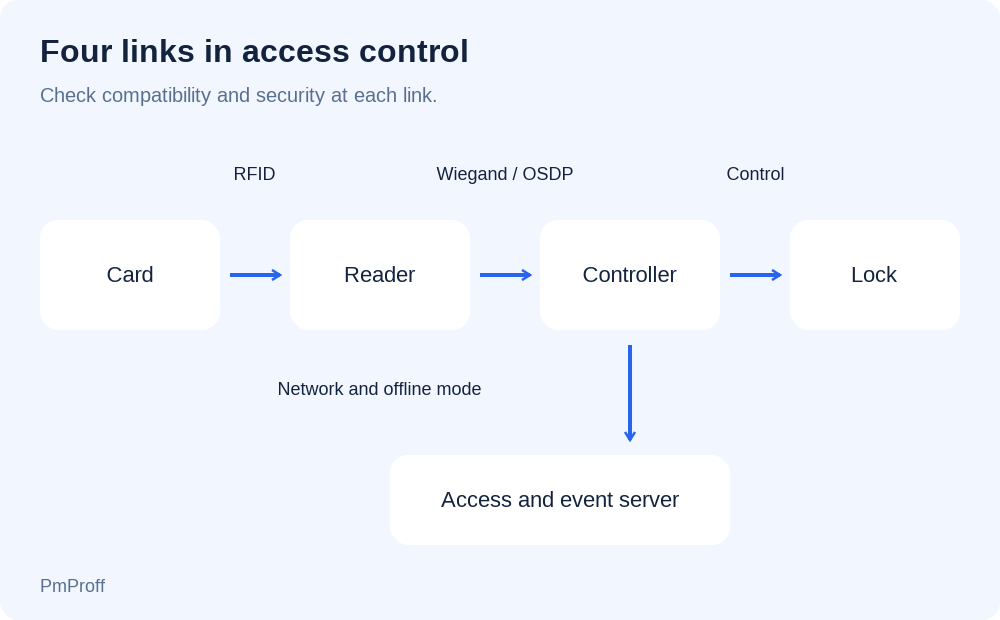
| Link | Check |
|---|---|
| Card → reader | Technology and identifier format |
| Reader → controller | Interface, message format and protection |
| Controller → lock | Output type and rated load |
| Controller → server | Synchronisation of access rights and events |
Card frequency and controller interface
125 kHz and 13.56 MHz refer to contactless communication with the card. Wiegand and OSDP apply to a different link, between the reader and controller. For more on cards, see the guide to RFID compatibility. A secure card does not automatically protect subsequent transmission of its data. Likewise, an AES label says little about the whole chain unless it specifies which link is protected.
OSDP and Secure Channel
OSDP supports two-way communication and features unavailable in basic Wiegand. SIA describes OSDP as an interface for peripheral interoperability and security. OSDP support alone does not establish that Secure Channel is enabled. SIA’s checklist recommends verifying Secure Channel configuration and interoperability before installation. This requires compatible devices and firmware, as well as appropriate key management. Review any test configuration before using it in production.
Offline operation, outputs and recovery
Check whether the controller retains access permissions offline, how it stores events and what happens when connectivity returns. Check the lock control output separately. Reader data does not power the lock. Contact type, load and emergency behaviour must meet the design. Test card revocation, schedule changes and restart as well as a successful entry.
Checks before choosing
- Check the card technology and data format.
- Verify the number the controller actually receives.
- For OSDP, confirm Secure Channel is active as well as supported.
- Test network loss and access revocation.
Frequently asked questions
Does Wiegand mean 125 kHz?
No. The terms describe different communication links.
Does OSDP automatically encrypt everything?
Do not assume so. Check both Secure Channel support and its active configuration.
Does a standalone controller still need testing after network loss?
Yes. Check which functions remain available locally and how synchronisation resumes.
In brief
Check the full chain: credential, message format, controller decision and lock output. One matching term in the specifications is insufficient.